



Differentiated Instruction with AI: How Personalized Homework Meets Every Student Where They Are
 2026.8.13
For international families planning to study in China, one of the most useful questions to ask a school is surprisingly simple: does every student receive the same learning task, or does the work change according to what each student actually needs? Personalized learning for students becomes meaningful when technology helps teachers identify learning gaps, adjust difficulty, provide timely feedback, and give students practice that is challenging without being overwhelming. At Hailiang, classroom experiments with AI-powered personalized learning show how differentiated instruction can move beyond educational theory and become part of everyday homework.
Quick Answer: What Is Differentiated Instruction?
Differentiated instruction is an approach in which teachers adjust learning tasks, support, difficulty, pace, or resources according to students’ different levels of readiness and learning needs.
AI can support this process by helping teachers see patterns in student performance and assign more targeted practice. The important point is that AI does not decide what education should look like on its own. Teachers remain responsible for learning goals, task design, interpretation of data, and individual support.
In practice, this can mean something very simple:
One student may need ten extra exercises on relative clauses.
Another may need additional listening practice.
A third may already understand the basic material and be ready for more demanding reading and writing.
They are in the same class, but they do not necessarily need the same homework.
That is the difference between simply digitizing homework and genuinely personalizing learning.
The Problem with One Assignment for Everyone
For decades, homework has often followed a familiar pattern.
One class receives one worksheet. Every student answers the same questions. Everyone submits the same assignment and later listens to the same explanation.
The system is easy to organize, but students do not learn at the same speed.
For students who have already mastered the material, repeated basic exercises can become unnecessary practice. For students who are still struggling with prerequisite knowledge, the same worksheet can feel impossibly difficult.
One group is under-challenged.
The other is overwhelmed.
Both can lose motivation.
English teacher Zheng Suya saw this problem clearly in her own classroom.
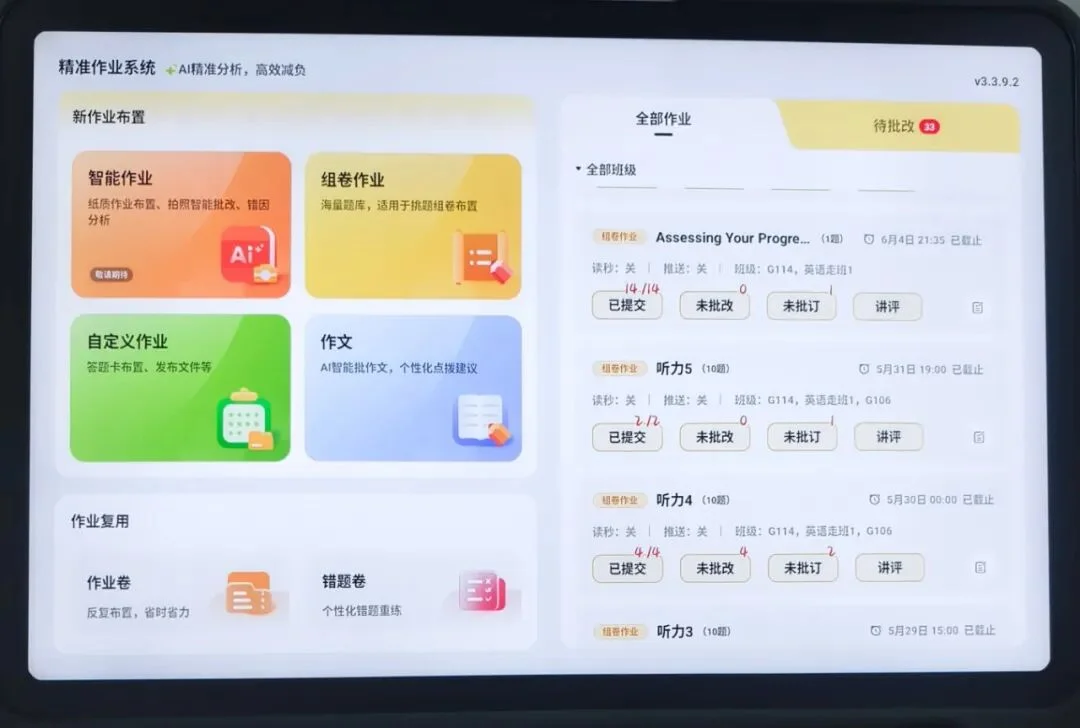
With multiple-choice tests, teachers traditionally had to rely partly on their impressions from marking papers to decide which questions needed explanation. Sometimes teachers even asked students to raise their hands to find out how many had answered a question incorrectly.
This made reviewing a test difficult.
Explain every question, and students who already understand the material may disengage.
Explain only selected questions, and the teacher risks overlooking students who still need help.
The problem is not a lack of effort.
It is a lack of sufficiently precise information.
From “One Worksheet” to Personalized Homework
At the Zhihe Division of Hailiang’s Hai Gao Campus, teachers are experimenting with a different model.
On Zheng’s assignment screen, students can appear in several different groups.
A group of students may receive targeted practice on relative clauses.
Five students may receive listening exercises.
Two may receive more advanced reading tasks.
In some cases, Zheng sends a particular exercise to only one student.
The class is still learning together, but the practice after class is no longer identical.
This is a practical form of differentiated instruction.
What makes it possible is not simply putting exercises on a tablet. The more important change is the learning-data loop behind the assignment.
The process begins before class, continues during the lesson, and ends with targeted practice after class.
Step 1: Pre-Class Tasks Identify the Starting Point
Traditional pre-class preparation is difficult for teachers to observe.
A teacher may ask students to preview a chapter, but it can be difficult to know who completed the task, what they understood, and where they became confused.
Digital learning makes part of that process visible.
Students might complete vocabulary practice in English, watch a short concept lesson in chemistry, or answer questions reviewing prerequisite knowledge in mathematics.
Teachers can then see completion and accuracy data before the next lesson begins.
Math teacher Cai Mengjiao used this approach while preparing a review lesson on probability distributions.
Her pre-class assignment included basic, intermediate, and more difficult questions.
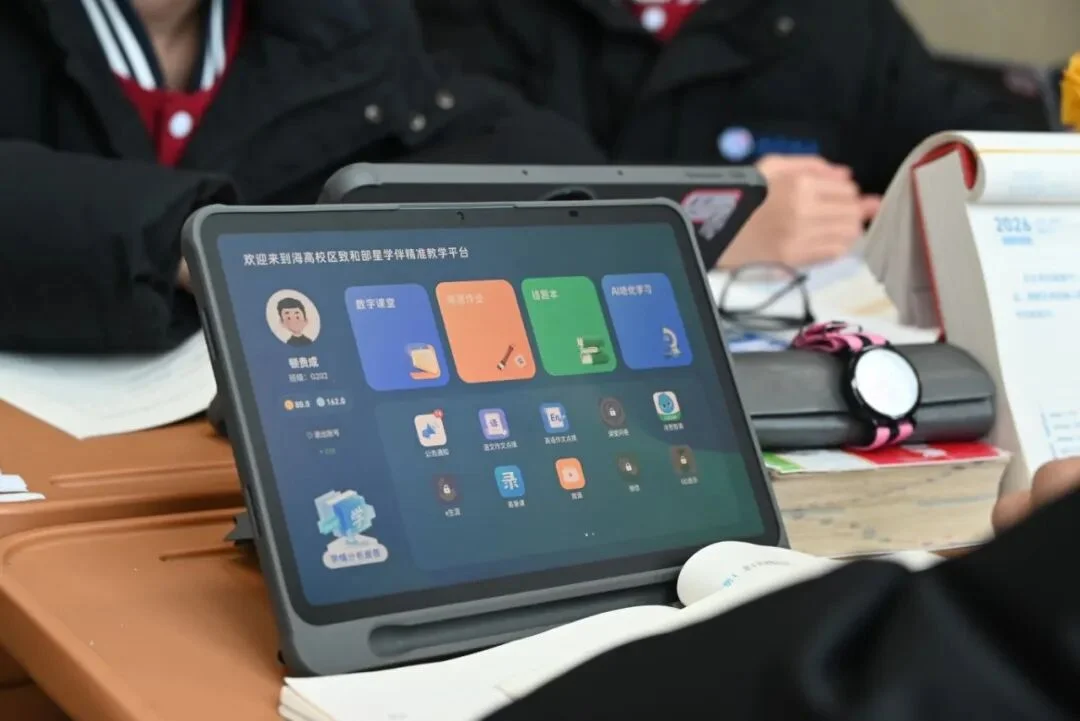
The results showed that students generally understood the fundamental concepts. Their problems were concentrated around two more difficult areas: identifying probability distributions and solving probability questions.
That information changed her lesson.
Instead of spending half the class reviewing concepts students already understood, she focused classroom time on the areas where students were actually struggling.
The result is an important principle behind adaptive learning:
Personalization should begin with evidence of what a learner currently understands.
Step 2: Classroom Responses Recalibrate the Learning Path
A student’s level of understanding is not fixed.
A student may enter a lesson confused and leave with strong understanding. Another may understand the first concept but struggle with the next.
That means personalized learning cannot depend on a label such as “strong student” or “weak student.”
It needs continual adjustment.
Geography teacher Chen Jianxia uses short classroom questions after teaching concepts such as pressure belts and wind systems.
Students answer on their devices, and she can see information including overall accuracy, common wrong answers, and which students selected them.
If only one or two students miss a question, the class does not need a long teacher explanation. Students can discuss it within their groups.
If seven or more students make the same mistake, the pattern suggests a common misconception that deserves more attention.
The same data can also help identify students who understand a question well enough to explain their reasoning to classmates.
The classroom therefore becomes more responsive.
Instead of:
Teach → assign → wait → mark → discover the problem
the cycle becomes:
Teach → check → identify → adjust → practice
That shorter feedback loop is one of the most useful applications of AI adaptive learning.
Step 3: Homework Responds to What Happened in Class
Chemistry teacher Jin Junhan describes short in-class practice as a kind of “mini health check.”
After teaching a concept, he gives students a short timed exercise.
If students demonstrate strong understanding, the follow-up assignment can emphasize extension and more challenging problems.
If the results show that key concepts are still weak, homework focuses on consolidation.
The goal is not to give advanced students more homework and struggling students less homework.
The goal is to give each student more useful homework.
At Zhihe, teachers often use a structure that combines:
core exercises for everyone;
optional intermediate practice;
advanced challenge questions;
targeted exercises for individual learning gaps.
This is where personalized learning pathways become concrete.
They do not have to mean that every student follows an entirely separate curriculum.
They can begin with small decisions about what a student should practice next.
The “Right Level of Difficulty” Matters
Educational thinkers have long argued that meaningful learning requires active engagement rather than passive reception.
The challenge, however, is deciding how difficult a task should be.
If it is far too easy, students may complete it without meaningful thinking.
If it is far too difficult, frustration can replace productive struggle.
Effective personalized education therefore looks for the space between the two.
The task should be achievable, but not automatic.
Students should need to think, make mistakes, adjust, and eventually succeed.
That experience matters because success after genuine effort creates a different type of motivation from simply finishing an assignment.
Students begin to think:
“I can do this.”
That belief can gradually change their relationship with learning.
Differentiated Homework Does Not Mean Lower Expectations
A common misunderstanding about personalized learning is that struggling students simply receive easier work.
That is not the goal.
Differentiation changes the route, not necessarily the destination.
A student who lacks important vocabulary may need accessible reading before moving to more complex texts.
A student who repeatedly makes the same grammar error may need concentrated practice on that specific structure.
A student who has already mastered grade-level material may need tasks that require deeper interpretation and application.
Different students may therefore be working at different points in the learning process while still moving toward clear academic goals.
That is why good differentiated homework needs both data and professional teacher judgment.
AI Gives Teachers Data. Teachers Give the Data Meaning.
The bigger change is not only what students do.
It is also what teachers do.
Previously, Zheng estimated that marking multiple-choice work for two classes could take more than two hours.
When routine marking and error statistics are handled digitally, teachers can redirect part of that time toward work that requires human expertise.
Zheng spends more time supporting students with weak foundations, helping advanced students with writing, and studying error patterns to decide what needs to be retaught.
For a relatively young teacher, the data also acts as a calibration tool.
Teaching a concept does not necessarily mean students have learned it.
Actual student responses make that distinction visible.
Jin has taken a similar approach to repeated questions. When a commonly missed problem needs detailed explanation, he can record a short solution video and attach it to the question.
Students who need the explanation can access it without waiting for the same problem to be retaught repeatedly.
The technology saves time, but the teacher decides how to reinvest that time.
This connects directly with Hailiang’s broader exploration of AI for teachers: the objective is not to remove teachers from the learning process, but to move more of their attention toward lesson design, diagnosis, explanation, encouragement, and individual support.
What Personalized Learning Should Not Become
AI-powered learning also creates risks if schools focus on technology rather than teaching.
Personalization should not mean placing students permanently into ability categories.
A learner who struggles with one chapter may excel in the next.
It should not mean maximizing screen time.
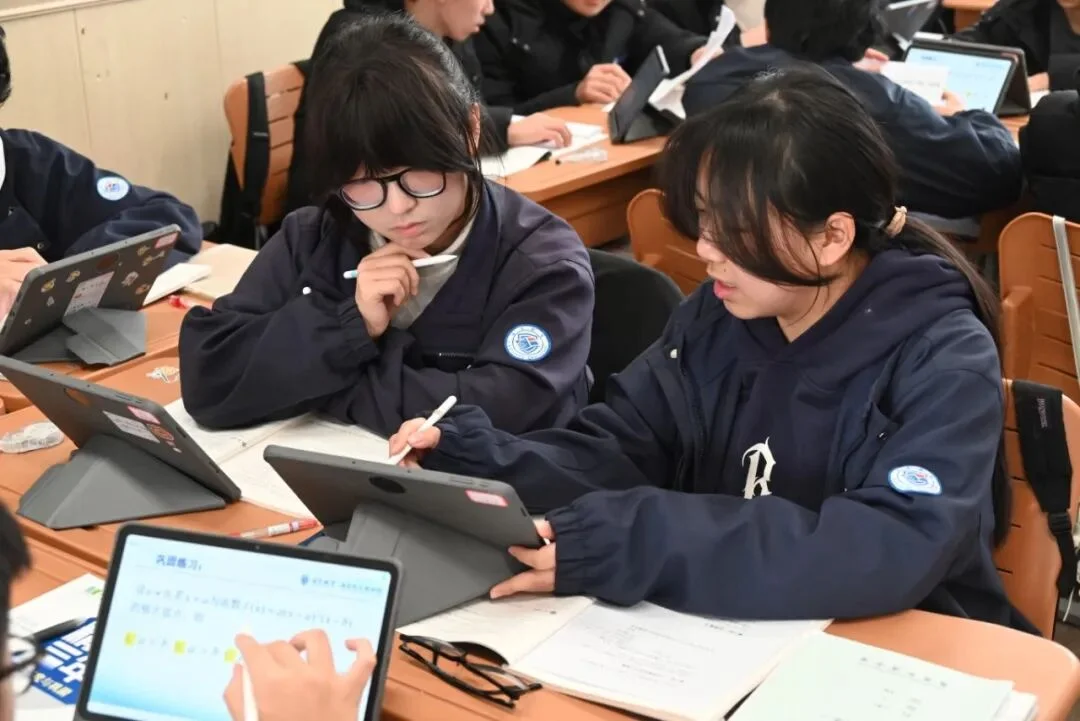
Digital tools are useful when they make learning needs visible and improve feedback, not simply because they are digital.
And it should not mean allowing an algorithm to replace professional judgment.
Teachers need to be able to question recommendations, change assignments, interpret unusual results, and understand factors that numbers may not capture.
The most effective system is therefore not “AI instead of teachers.”
It is AI-supported teacher decision-making.
What Should Families Look for When Choosing a School in China?
For international families comparing an international school in China, the words “AI-powered” or “personalized” alone tell you very little.
Ask more specific questions:
How does the school identify individual learning gaps?
A strong answer should include more than examination scores.
Does every student receive the same homework?
Uniform assignments are not always wrong, but schools should have ways to provide targeted support and appropriate challenge.
How quickly do teachers receive feedback about student understanding?
A shorter feedback cycle allows problems to be addressed before misconceptions become deeply established.
Can teachers override recommendations made by technology?
They should.
Does personalization lead to greater student independence?
The long-term goal should be stronger learners, not students who become dependent on software.
Families planning a longer academic pathway in China may also want to explore HIS’s Chinese Curriculum Pathway, which combines academic study, Chinese-language development, HSK preparation, and university pathway planning.
From More Homework to Better Homework
The most important change taking place in these classrooms is easy to miss.
Students are not necessarily receiving more exercises.
They are receiving more relevant ones.
Teachers are not simply collecting more data.
They are using information to decide what deserves classroom time and what each student should practice next.
And AI is not being asked to replace teaching.
It is helping make parts of the learning process visible that were previously difficult to see.
That is the real promise of differentiated instruction.
Not a different education for every student, but a more appropriate next step for each learner.
For families considering where to study in China, that may be one of the most meaningful signs of a school that takes personalized education seriously.
Frequently Asked Questions
What is differentiated instruction?
Differentiated instruction is a teaching approach that adjusts tasks, support, difficulty, resources, or pacing according to students’ different learning needs while maintaining clear academic goals.
What is the difference between differentiated instruction and personalized learning?
Differentiated instruction usually describes adjustments made by teachers for different learners or groups. Personalized learning can go further by using individual progress, goals, interests, or performance data to shape a student’s learning pathway.
What is adaptive learning?
Adaptive learning uses student performance data to adjust the content, difficulty, sequence, or support provided to a learner. Digital systems can make these adjustments more quickly, although teachers should remain involved in educational decisions.
How can AI support personalized learning for students?
AI can help analyze student responses, identify recurring learning gaps, organize practice, generate targeted feedback, and recommend appropriate next steps. Teachers still need to verify the results and decide how those recommendations fit the student’s wider learning needs.
What is personalized homework?
Personalized homework is practice selected according to a student’s current learning needs rather than assigning exactly the same exercises to every learner. It may include targeted remediation, core practice, or more challenging extension work.
Is personalized homework better than traditional homework?
It can be more useful when personalization is based on reliable evidence of student understanding and supported by teacher judgment. Personalization alone does not guarantee better learning.
Can AI replace teachers in differentiated instruction?
No. AI can process data and support recommendations, but teachers remain responsible for learning goals, relationships, motivation, classroom culture, and professional judgment.
How can parents tell whether a school really uses personalized learning?
Ask how the school identifies learning gaps, how assignments change in response to student performance, how quickly feedback reaches students, what role teachers play in AI-supported decisions, and how the school measures student progress.