



Gifted Students in Mathematics: How Schools Help Talent Grow
 2026.8.29
A student finishes the mathematics work long before everyone else.
Another student may not calculate particularly quickly, but notices patterns that classmates do not see. A third keeps asking questions that go far beyond what the textbook is designed to explain.
Should all three simply be given harder worksheets?
Probably not.
For gifted students in mathematics, effective education is rarely about assigning more of the same work. Advanced learners often need greater depth, more complex problems, flexible pacing and opportunities to explore ideas beyond the standard curriculum.
This is one of the central questions in modern gifted education: how can schools identify advanced potential and provide enough challenge for it to continue developing?
For families considering an international school in China, the question is especially important. Curriculum matters, but so does a school’s ability to respond when a student’s academic needs fall outside the typical pace of the classroom.
What Are Gifted Students in Mathematics?
There is no single profile that defines all gifted students in mathematics.
Some students demonstrate unusually rapid mastery of mathematical concepts.
Others show exceptional spatial reasoning, pattern recognition or logical thinking.
Some are drawn naturally toward proof and abstraction, while others become deeply absorbed in solving unfamiliar problems.
Characteristics may include:
rapid understanding of mathematical concepts;
strong pattern recognition;
unusually advanced logical or spatial reasoning;
curiosity about ideas beyond grade-level content;
creative approaches to unfamiliar problems;
the ability to generalize from examples;
persistence with complex questions;
and an interest in understanding why mathematical rules work.
Importantly, being mathematically gifted does not necessarily mean being the fastest student in the classroom.
Speed is only one possible indicator.
A student who spends a long time investigating one problem but discovers a highly original solution may demonstrate a different form of mathematical strength.
That is why high-quality identification should look beyond a single test score.
Gifted Education Is Not Simply About Moving Faster
When parents first recognize advanced ability, one of the most common questions is:
“Can my child move to the next grade’s mathematics?”
Sometimes acceleration is appropriate.
But gifted and talented education involves much more than allowing students to complete the same curriculum earlier.
Three approaches are particularly important.
Acceleration
Acceleration allows students to move through material more quickly when they have already demonstrated mastery.
This might involve subject acceleration, advanced classes or earlier access to higher-level mathematics.
Enrichment
Enrichment keeps students at an appropriate curricular stage while giving them deeper or broader problems.
Instead of learning another formula, students might investigate why a formula works, compare alternative methods or explore what happens when assumptions change.
Differentiation
Differentiation adjusts tasks according to student readiness.
The learning objective, level of complexity, pace, resources or expected output may change depending on what a student already understands.
Effective programs often combine all three.
The central question should not be:
“How can we make the student work more?”
It should be:
“What kind of mathematical thinking does this student need next?”
Why Differentiated Instruction for Gifted Students Matters
Consider two students sitting in the same mathematics classroom.
One is still developing confidence with a new concept.
The other mastered it several lessons ago.
Giving both students exactly the same repeated practice may be convenient, but it does not necessarily meet either student’s learning needs.
Differentiated instruction for gifted students begins by identifying what a learner already understands and then adjusting the level of intellectual challenge.
For example, imagine a student has already mastered routine quadratic equations.
Assigning another 30 nearly identical equations may increase workload without increasing learning.
A differentiated task might instead ask the student to:
compare different solution methods;
investigate how changing coefficients affects the roots;
create an equation satisfying a particular set of conditions;
prove a relationship;
or connect the problem to graphical or geometric representations.
The student may complete fewer questions.
But the mathematical thinking becomes deeper.
This distinction is central to meaningful personalized learning.
Hailiang International School has also explored how technology can support this process through differentiated instruction and personalized homework.
Digital tools can help teachers identify patterns in student performance and shorten feedback cycles, but technology alone does not create differentiation.
Teacher judgment remains essential.
What Does Good Mathematics Enrichment Look Like?
Mathematical enrichment should not be confused with introducing advanced formulas to younger students as early as possible.
Good enrichment develops mathematical thinking.
Depending on the age and readiness of the learner, this may involve:
non-routine problem solving;
mathematical proof;
open-ended investigations;
mathematical modeling;
connections between geometry, algebra and number theory;
coding and computational mathematics;
research-style projects;
math circles;
academic competitions;
and discussion with similarly motivated students.
These experiences help advanced learners move beyond procedural fluency.

Instead of asking only:
“How do I solve this?”
students begin asking:
“Why does this work?”
“Will it always work?”
“What changes if one condition changes?”
“Can I prove it?”
“Is there another way?”
That shift is crucial.
Strong mathematics education does not simply produce students who know more mathematics.
It helps students think more mathematically.
Are Math Competitions Good for Gifted Math Students?
For some gifted math students, mathematics competitions provide exactly the kind of challenge that is missing from routine classroom work.
Olympiad-style problems are rarely solved by applying a familiar formula immediately.
Students must experiment, recognize hidden structures, construct logical arguments and continue working even when the solution is not obvious.
Competitions can therefore strengthen:
problem-solving flexibility;
proof-writing;
logical reasoning;
persistence;
creative thinking;
and comfort with unfamiliar questions.
The International Mathematical Olympiad represents the highest level of this competition pathway for secondary-school students.
But competition performance should never become the definition of mathematical giftedness.
Not every mathematically gifted student enjoys competitive environments.
Some may develop more strongly through mathematical modeling, programming, theoretical study or research-style exploration.
A strong school therefore treats competitions as one pathway among several—not as the only evidence of mathematical potential.
Haojia Shi: From Gifted Math Student to University Mathematics
One particularly visible example of long-term mathematical development is Haojia Shi.
Shi studied within the Hailiang Education system before entering Peking University.
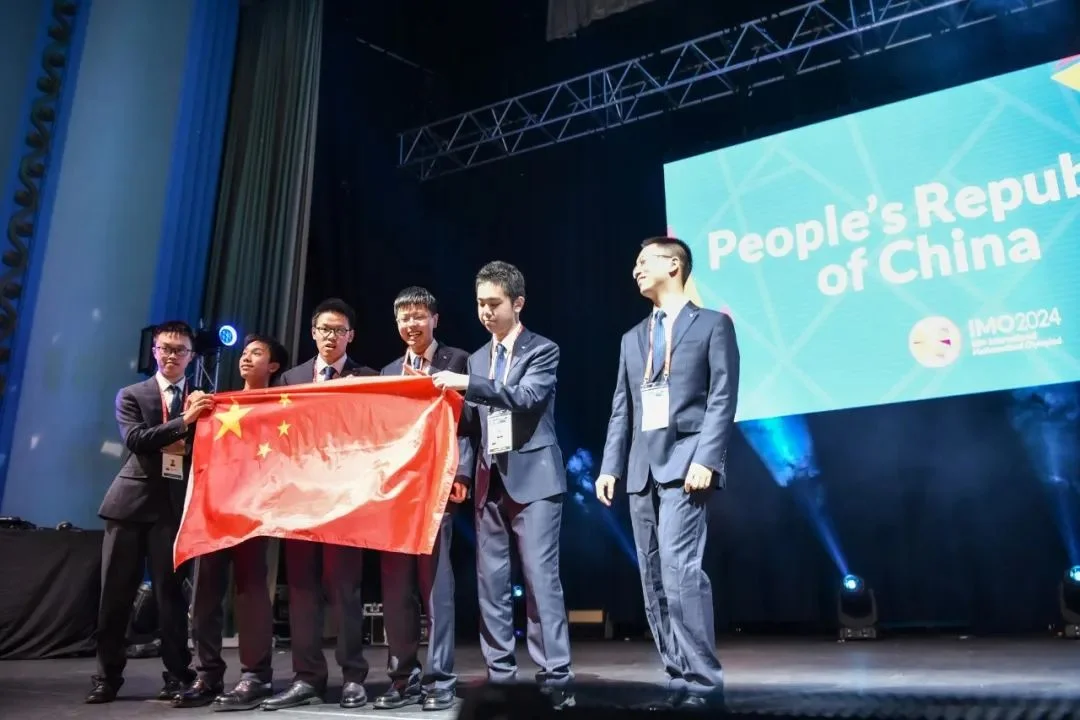
In 2023, he represented China at the International Mathematical Olympiad and achieved a perfect score of 42/42.
In 2024, he did it again.
Two consecutive perfect IMO performances made him one of the most notable young mathematics competitors of his generation.
But his later development is perhaps even more relevant to the discussion of gifted students in mathematics.
In 2026, Shi competed in the S.-T. Yau College Student Mathematics Contest and won the Individual All-Round Gold Medal.
He also earned Gold Medals in Analysis and Differential Equations and Geometry and Topology, together with a Silver Medal in Algebra, Number Theory and Combinatorics.
Why does this matter educationally?
Because Olympiad mathematics and university mathematics demand different kinds of preparation.
The IMO demonstrates extraordinary school-level problem-solving ability.
Success across several university mathematics disciplines requires a much broader theoretical foundation.
Shi’s trajectory therefore illustrates an important principle of talent development:
Early ability needs somewhere to go next.
What Can We Learn From Haojia Shi’s Development?
It would be misleading to argue that one school, one teacher or one training method “created” an exceptional mathematics student.
Talent development does not work that way.
Individual ability interacts with motivation, teaching, family support, peers, academic opportunities and many other factors.
But Shi’s experience does highlight several principles relevant to gifted education.
First, advanced ability needs to be recognized.
If students repeatedly demonstrate mastery far beyond normal expectations, keeping them indefinitely within the same academic ceiling can restrict development.
Second, challenge needs to increase gradually.
Students should not simply be pushed toward harder material for the sake of difficulty. Advanced learning needs a coherent progression.
Third, mentorship matters.
At higher levels, expert teachers can help students see mathematical connections that are difficult to develop through independent practice alone.
Fourth, opportunities matter.
Competitions, advanced courses, enrichment programs and interaction with strong peers can expose students to mathematical environments beyond their normal classroom.
Finally, development requires time.
Exceptional ability at age 10 or 15 is not a finished product.
It is potential still being developed.
Gifted Education in China
China has a long history of identifying and supporting students with exceptional academic potential.
Different approaches have developed over time, including specialized classes, advanced academic programs, mathematics and science competitions, university-linked talent initiatives and individualized learning pathways.
In recent years, greater attention has also been placed on developing innovative talent rather than focusing only on examination performance.
This distinction matters.
Traditional academic success often rewards students for mastering known material accurately.
Advanced talent development eventually requires students to move beyond known answers.
They need opportunities to explore, question, investigate and create.
For international families considering whether to study in China, it is therefore useful to look beyond curriculum labels.
Ask how a school responds when a student demonstrates unusual academic readiness.
Does the student have access to deeper learning?
Can the pace change?
Are advanced teachers available?
Can students participate in enrichment or competitions?
Does the school have a pathway beyond the standard classroom curriculum?
These questions reveal much more about an educational environment than a brochure’s use of the word “personalized.”
What Should Parents Look for in a School?
Parents of mathematically advanced children do not necessarily need a school formally labeled as a gifted school.
They need evidence that the school has enough flexibility to respond to different levels of readiness.
Several questions can help.
How does the school identify advanced learners?
One test should rarely determine everything.
Schools can consider assessment results, classroom reasoning, learning speed, teacher observations, student interests and evidence of advanced problem solving.
Can students work above grade level when appropriate?
Ask whether the school can provide advanced content when a student has clearly mastered current material.
Does the school offer enrichment?
Competitions are one option, but look for broader opportunities such as projects, research activities, STEM programs, mathematical investigations and academic clubs.
What does personalized learning actually mean?
A strong answer should describe how teachers assess readiness, adjust tasks and monitor development.
It should be more specific than “every student is unique.”
Can students meet peers with similar academic interests?
Peer interaction matters, especially for students whose academic interests are unusual within their age group.
What happens after acceleration?
This is one of the most important questions.
Moving a student one year ahead solves an immediate problem.
Schools also need to think about what happens when that student reaches the next academic ceiling.
Choosing an Academic Pathway in China
For international students, advanced mathematics is only one part of choosing the right school.
Language of instruction and future university plans are equally important.
Students planning to pursue higher education in China may benefit from a pathway that develops Chinese-language academic ability alongside the standard curriculum.
Hailiang International School’s Chinese Curriculum Pathway is designed for international students seeking Chinese-medium education and preparation for future university study in China.
Students seeking an internationally recognized English-medium route can explore the Cambridge Pathway.
The best choice depends on the individual student.
A mathematically advanced learner planning to attend a Chinese university may need a very different combination of language, curriculum and academic preparation from a student planning to apply to universities in the United Kingdom or United States.
This is why academic pathway planning should begin with the student’s long-term goals.
Supporting Talent Without Turning Childhood Into a Competition
There is another side to gifted and talented education that schools and parents should not overlook.
Advanced ability can create expectations.
Once a child becomes known as “the math student,” every examination, competition or academic result may begin to feel like a test of identity.
That can be unhealthy.
A strong educational environment should challenge talented students without reducing them to their achievements.
They still need opportunities to fail.
They need problems they cannot immediately solve.
They need interests outside their strongest academic subject.
They need friendships, physical activity and ordinary school experiences.
And they need permission to change direction.
A student who demonstrates exceptional mathematical ability at age 12 should have opportunities to develop that ability.
But that student should not feel that a mathematical career has already been chosen for them.
The role of education is to expand possibilities, not narrow them.
What Gifted Students in Mathematics Need Most
Exceptional academic ability often attracts attention through visible achievements: high scores, difficult courses, competition medals or unusually advanced work.
The more important work happens over years.
Teachers need to recognize when a student is ready for greater challenge.
Schools need enough flexibility to provide that challenge.
Parents need to support development without turning every educational experience into a performance.
And students need environments where curiosity can grow alongside ability.
Two gifted students in mathematics may have completely different needs.
One may benefit from acceleration.
Another may need deep enrichment.
Another may thrive through competitions.
Another may discover a passion for mathematical research, computer science or physics.
That is precisely why effective gifted education cannot be reduced to one program.
Talent may appear early.
The quality of the educational environment helps determine what that talent has the opportunity to become.
Popular Search Questions
What are gifted students in mathematics?
Gifted students in mathematics are learners who demonstrate unusually advanced mathematical reasoning, understanding, creativity or problem-solving ability relative to typical expectations for their age or educational stage.
What are the signs of a gifted math student?
Signs may include rapid understanding of mathematical concepts, strong pattern recognition, advanced logical reasoning, unusual curiosity, creative problem-solving strategies and sustained interest in complex mathematical questions.
How should schools teach gifted math students?
Schools can combine acceleration, enrichment and differentiation. Gifted math students generally benefit from appropriately challenging tasks, deeper problem solving, flexible pacing and opportunities to explore mathematics beyond the standard curriculum.
What is differentiated instruction for gifted students?
Differentiated instruction for gifted students means adapting the content, pace, complexity, learning process or expected outcome according to what a student already understands and is ready to learn next.
Are math competitions useful for gifted students?
Yes, for some students. Competitions can strengthen problem solving, proof-writing, persistence and creative reasoning. However, they should be treated as one possible pathway rather than the only measure of mathematical ability.
Is gifted education the same as acceleration?
No. Acceleration is one strategy within gifted education. Gifted learners may also benefit from enrichment, differentiated teaching, mentorship, research opportunities and specialized academic experiences.
How does China support gifted students in mathematics?
China uses several approaches, including advanced academic programs, mathematics competitions, specialized talent initiatives, university-linked programs and differentiated educational pathways. The exact opportunities vary between schools and regions.
Can international students study mathematics in China?
Yes. International students can attend Chinese-medium or international-curriculum schools in China. Families should compare curriculum level, teaching language, advanced learning opportunities and future university pathways when choosing a school.