



Haojia Shi: From Two Perfect IMO Gold Medals to Yau Contest Gold
 2026.8.28
How far can exceptional mathematical talent develop when early ability is matched with sustained academic challenge?
For Haojia Shi, the answer is beginning to take shape.
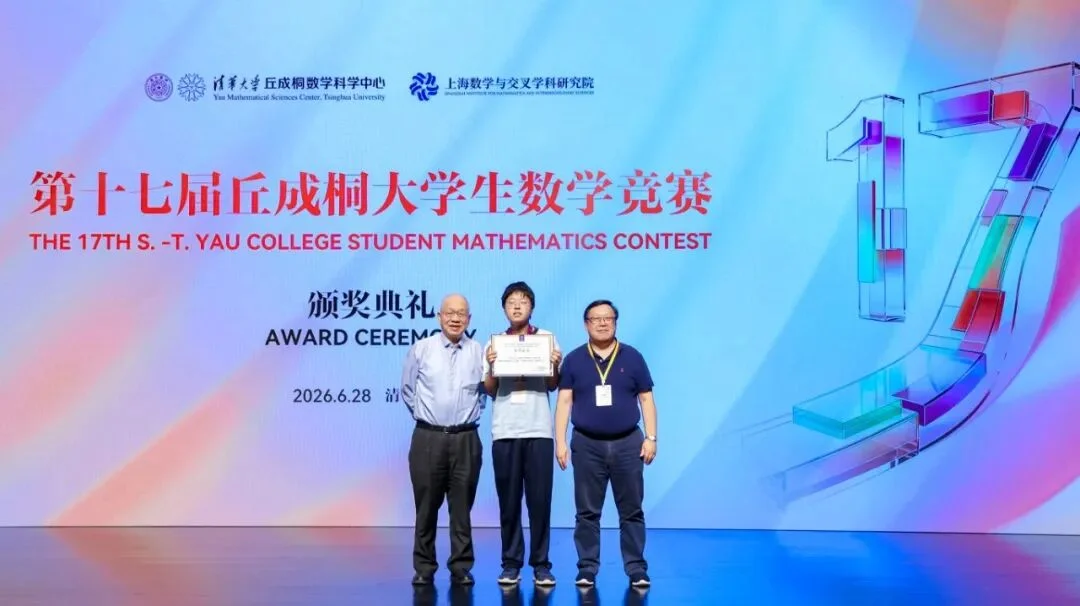
On June 28, 2026, Haojia Shi, a Hailiang Education alumnus now studying at Peking University, won the Gold Medal in the Shing-Tung Yau Individual All-Round Award at the 17th S.-T. Yau College Student Mathematics Contest.
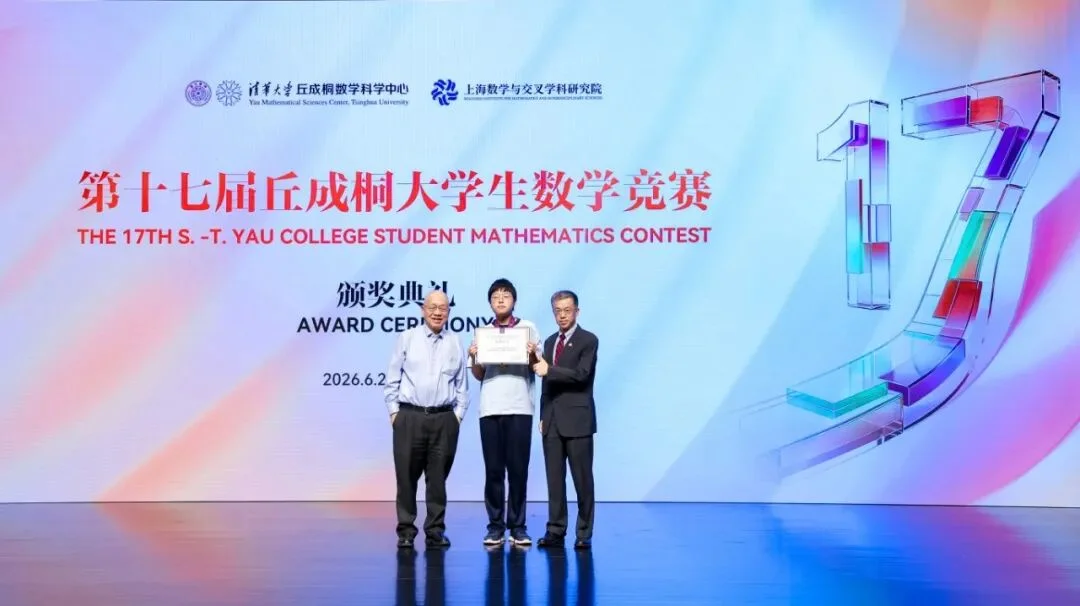
He also earned Gold Medals in Analysis and Differential Equations and Geometry and Topology, together with a Silver Medal in Algebra, Number Theory and Combinatorics.
The achievement adds another milestone to a mathematics record that had already attracted international attention. In both 2023 and 2024, Shi represented China at the International Mathematical Olympiad and achieved a perfect score of 42 out of 42.
For students and families interested in mathematics education—and for international families considering opportunities to study in China—his story offers more than an impressive collection of medals.
It shows how exceptional school-level mathematical problem-solving ability can develop into the broader mathematical knowledge required at university.
Who Is Haojia Shi?
Haojia Shi, whose name may also appear in Chinese-name order as Shi Haojia, is a young Chinese mathematics student currently studying at Peking University.
Internationally, he first attracted attention through the International Mathematical Olympiad, widely regarded as the leading mathematics competition for secondary-school students.
At the 2023 IMO, Shi scored the maximum possible 42 points and received a Gold Medal.
He repeated the achievement in 2024, again receiving 7 points on all six problems for a total score of 42/42.
Achieving one perfect IMO score is already rare. Repeating it in consecutive years demonstrates an exceptional level of consistency in mathematical reasoning, proof construction and problem solving.
Yet Shi’s development did not begin at the IMO.
His mathematical ability had emerged much earlier. During his school years within the Hailiang Education system, he progressed rapidly through increasingly advanced mathematical challenges.
By 2022, he had entered China’s national mathematics training team, earning eligibility for recommendation to leading Chinese universities. He later represented China at the IMO in both 2023 and 2024.
His journey therefore provides a useful example of what can happen when advanced mathematical potential is identified early and supported over time.
Why Are Two Perfect IMO Scores So Rare?
The International Mathematical Olympiad is not simply a test of how much mathematics a student knows.
Competitors face six highly demanding problems over two days. Each problem is worth seven points, producing a maximum possible score of 42.
The questions require students to work within areas such as algebra, geometry, number theory and combinatorics, but success depends much less on memorizing formulas than on recognizing unfamiliar structures and constructing rigorous mathematical arguments.
This distinction matters.
A student can be academically excellent in mathematics without becoming an IMO gold medalist. Olympiad problems require a particular combination of creativity, logical precision, persistence and the ability to discover approaches under considerable time pressure.
Shi achieved six scores of 7/7 in 2023 and repeated exactly the same result in 2024.
That makes his record significant even among students who have reached the highest level of international mathematical competition.
But Olympiad success raises another question.
What happens after the Olympiad?
From Olympiad Problem Solving to University Mathematics
Being an outstanding international mathematical Olympiad winner and becoming an academic mathematician are not the same thing.
Olympiad mathematics is built around carefully designed problems. Students know that a solution exists and that they need to find it within a limited period of time.
University mathematics gradually demands something different.
Students must master broader theoretical frameworks, work comfortably with abstraction, understand definitions and proofs at a deeper level and make connections across different branches of mathematics.
Eventually, those who continue into research must learn to investigate questions for which nobody has prepared an answer in advance.
This is why Shi’s performance at the 2026 S.-T. Yau College Student Mathematics Contest is particularly interesting.
His results suggest that his mathematical strength is developing beyond secondary-school Olympiad problem solving and into a much broader university-level foundation.
What Is the S.-T. Yau College Student Mathematics Contest?
Founded in 2010 by mathematician Shing-Tung Yau, the S.-T. Yau College Student Mathematics Contest is designed to identify and develop outstanding undergraduate mathematics students.
In 2026, the competition entered a new stage of international development and accepted participants from universities around the world.
Unlike the IMO, which focuses on secondary-school problem solving, the Yau Contest covers major areas of modern undergraduate mathematics.
Its individual competitions include:
Analysis and Differential Equations
Geometry and Topology
Algebra, Number Theory and Combinatorics
Probability and Statistics
Applied and Computational Mathematics
Mathematical Physics
Students may also compete for the Shing-Tung Yau Individual All-Round Award, which recognizes broad mathematical strength across subject areas.
Shi’s 2026 results therefore stand out not only because he won the All-Round Gold Medal, but because he also performed at the highest level across several distinct mathematical disciplines.
What Did Haojia Shi Win in 2026?
At the 17th S.-T. Yau College Student Mathematics Contest, Haojia Shi received:
Gold Medal — Shing-Tung Yau Individual All-Round Award
Gold Medal — Hua Luogeng Award for Analysis and Differential Equations
Gold Medal — S.-S. Chern Award for Geometry and Topology
Silver Medal — Chou Wei-Liang Award for Algebra, Number Theory and Combinatorics
Taken together, these results reveal something different from an isolated competition victory.
Analysis, geometry and algebra require different ways of mathematical thinking. Performing strongly across all three suggests considerable breadth in addition to problem-solving ability.
That breadth is one of the reasons Shi’s development has received so much attention.
Why Is Haojia Shi Compared With Wei Dongyi?
Chinese media have frequently compared Haojia Shi with mathematician Wei Dongyi.
The comparison is understandable.
Wei became widely known after earning perfect Gold Medal performances at the IMO in 2008 and 2009. After entering Peking University, he also achieved outstanding results in the S.-T. Yau College Student Mathematics Contest.
Shi has now followed an unusually similar competition trajectory: two perfect IMO Gold Medals followed by the highest All-Round honor at the Yau Contest.
However, describing Shi simply as “the next Wei Dongyi” can oversimplify the story.
Mathematical careers are not predetermined by competition results.
Two young mathematicians may demonstrate similarly exceptional ability and still develop in completely different research directions.
The more meaningful comparison is therefore not whether Shi will become another Wei Dongyi.
It is whether the rare combination of Olympiad-level creativity and increasingly broad university mathematics can eventually develop into original mathematical research.
That story is still being written.
Mathematical Talent Is More Than Fast Calculation
Stories about young mathematics talents can sometimes create the wrong impression.
Exceptional mathematics is not simply about calculating faster than everyone else.
In fact, advanced mathematical ability often appears through characteristics such as:
recognizing hidden patterns;
forming abstract connections;
developing multiple approaches to one problem;
asking unusually deep questions;
constructing rigorous arguments;
remaining engaged with difficult problems for long periods;
and moving comfortably between concrete examples and general principles.
This is why schools need to distinguish between students who are merely ahead in curriculum content and students who may need fundamentally different levels of intellectual challenge.
Shi’s experience illustrates the importance of this distinction.
Moving faster was only one part of his development. Sustained exposure to deeper mathematics, competition-level problem solving and increasingly advanced academic environments was equally important.
What Can Schools Learn From Exceptional Mathematics Students?
When parents see a student demonstrating unusual academic ability, the natural response is often to search for one decisive solution: a stronger teacher, a harder textbook or a prestigious competition.
In practice, long-term talent development is usually more complex.
Advanced students may need a combination of:
earlier access to challenging material;
teachers who recognize when normal classroom tasks are no longer sufficient;
opportunities for deep mathematical problem solving;
individualized academic planning;
interaction with similarly motivated peers;
and pathways that allow students to explore mathematics beyond examination requirements.
The broader Hailiang Education system has long placed emphasis on differentiated student development and individualized academic planning.
For international families exploring education in China, this principle remains relevant even when a student is not an Olympiad-level mathematician.
Different students have different strengths.
A school should therefore be able to recognize where a student is ready for greater challenge and provide an appropriate next step.
Families interested in Chinese-medium academic development can explore the Chinese Curriculum Pathway, designed for international students who want to strengthen Chinese-language academic learning and prepare for future university study in China.
Why Does Advanced Mathematics Matter Beyond Competitions?
For many students, mathematics appears to be one subject among many.
At a deeper level, however, mathematics provides much of the conceptual foundation for modern science and technology.
Cryptography relies heavily on number theory.
Satellite navigation and aerospace engineering depend on differential equations.
Artificial intelligence draws on linear algebra, probability, statistics and optimization.
Scientific modeling in fields ranging from climate research to pharmaceutical development relies on mathematical structures.
Basic mathematical research does not always produce immediate commercial applications.
Its influence can emerge decades later.
Ideas originally developed within pure mathematics have repeatedly become essential tools in physics, computing, engineering and other sciences.
This is one reason countries continue to invest in identifying and developing highly capable mathematics students.
Supporting exceptional mathematical talent is not simply about winning competitions.
It is about building the intellectual foundation from which future research may emerge.
A Beginning Rather Than a Finish Line
Haojia Shi’s achievements are already remarkable.
He earned perfect scores at two consecutive International Mathematical Olympiads and then demonstrated broad undergraduate mathematical strength by winning the Individual All-Round Gold Medal at the S.-T. Yau College Student Mathematics Contest.
But at the university level, medals increasingly become part of the background.
Research asks different questions.
Can a young mathematician stay with one difficult problem for months or even years?
Can they identify questions worth asking?
Can they build new arguments rather than solve carefully designed competition problems?
Can they contribute something genuinely new?
Those questions cannot be answered by an Olympiad score.
For Haojia Shi, the most interesting stage may therefore be the one that comes next.
Popular Search Questions
Who is Haojia Shi?
Haojia Shi, also known as Shi Haojia, is a Chinese mathematics student at Peking University. He earned perfect 42/42 scores and Gold Medals at both the 2023 and 2024 International Mathematical Olympiads and won the Individual All-Round Gold Medal at the 2026 S.-T. Yau College Student Mathematics Contest.
Did Haojia Shi get a perfect score at the International Mathematical Olympiad?
Yes. Haojia Shi scored the maximum 42/42 at both the 2023 and 2024 International Mathematical Olympiad.
How many IMO Gold Medals has Haojia Shi won?
Haojia Shi won two IMO Gold Medals, representing China in 2023 and 2024. He achieved a perfect score in both competitions.
What did Haojia Shi win at the 2026 Yau Mathematics Contest?
He won the Individual All-Round Gold Medal, Gold Medals in Analysis and Differential Equations and Geometry and Topology, and a Silver Medal in Algebra, Number Theory and Combinatorics.
Why is Haojia Shi compared with Wei Dongyi?
The comparison comes from their unusual competition trajectories. Both achieved consecutive perfect IMO Gold Medals and later demonstrated exceptional performance in the S.-T. Yau College Student Mathematics Contest. It is best understood as a comparison of early mathematical achievement rather than a prediction that their academic careers will be the same.
Is Haojia Shi a Hailiang International School graduate?
No. Haojia Shi studied at Hailiang Senior High School within the wider Hailiang Education system. Hailiang International School is a separate school serving international students.