



From “I Have To” to “I Want To”: How Formative Assessment Builds Self-Directed Learning
 2026.8.18
For families choosing where to study in China, academic results matter, but so does a less visible outcome: can students gradually learn how to manage their own learning? Learning analytics in education and AI formative assessment are useful only when they help students understand what they know, identify what they still need to work on, and take the next step themselves. Classroom practice within the wider Hailiang education network shows how data-driven instruction can shorten the distance between making a mistake, understanding it, and deciding what to learn next.
Quick Answer: How Does Formative Assessment Support Self-Directed Learning?
Formative assessment gives students and teachers information about learning while learning is still taking place.
Instead of waiting for a final exam to discover what went wrong, students receive feedback early enough to change what they do next.
When students can see their own learning gaps, access targeted explanations, retry difficult questions, and choose additional practice, formative assessment can gradually support self-directed learning.
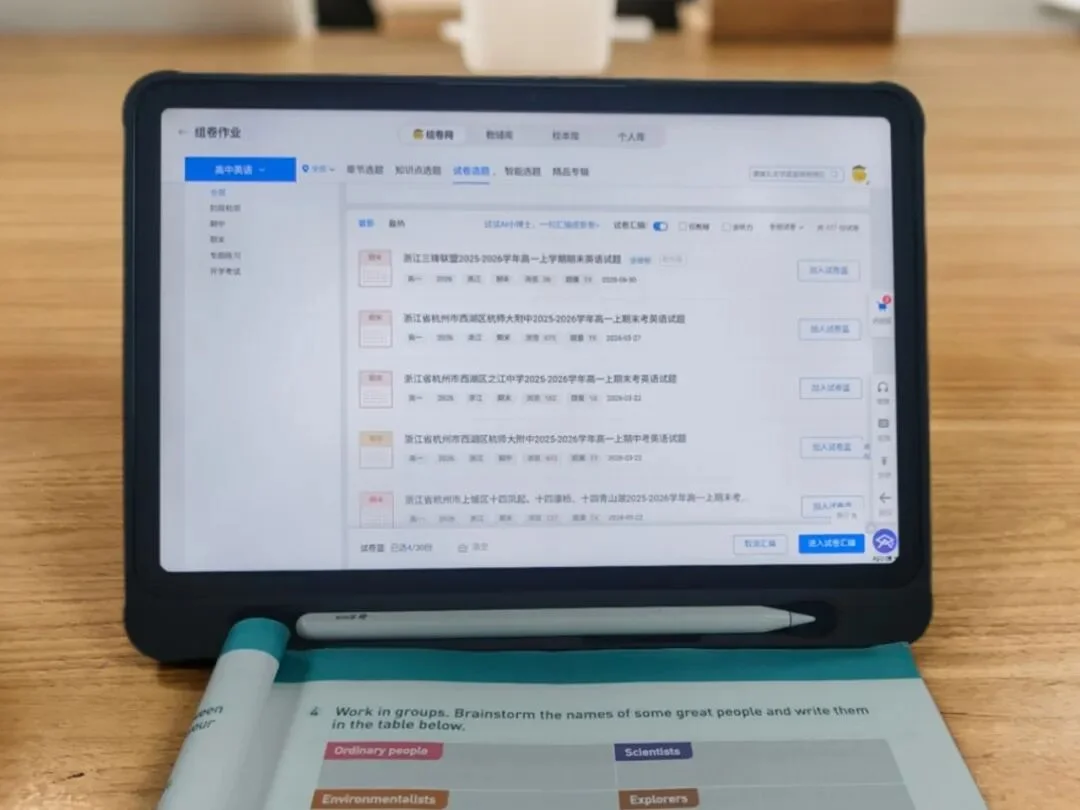
The goal is not simply better scores.
It is helping students become increasingly capable of answering three questions for themselves:
What do I understand?
Where am I struggling?
What should I do next?
The Hidden Cost of Delayed Feedback
Consider a familiar homework problem.
A student spends twenty minutes struggling with a mathematics question.
Classmates are busy.
The teacher is unavailable.
The student eventually gives up and waits until the next day’s lesson.
By the time the teacher explains the question, the student may no longer remember exactly where the reasoning broke down.
Student Tu Chengwei described a similar experience.
Before digital learning support became more integrated into his routine, getting stuck could mean waiting until the next day for an explanation.
The problem was not only that help came late.
The learning moment had already passed.
This illustrates one of the most important functions of formative assessment: reducing the gap between a learning difficulty and useful feedback.
Formative Assessment Is Not Just Another Test
The word “assessment” often makes students think of grades.
But formative assessment serves a different purpose.
A final examination usually asks:
What has the student learned?
Formative assessment asks:
What does the student understand right now, and what should happen next?
That difference changes how assessment can be used.
In an AI-supported classroom, a teacher might give students a short question immediately after explaining a concept.
Within minutes, the teacher can see whether most students understand it.
If nearly everyone is correct, the class can move forward.
If several students choose the same wrong answer, the teacher has evidence of a shared misconception.
If one student repeatedly struggles with a particular concept, that student may need targeted practice after class.
Assessment therefore becomes part of teaching rather than something that happens only after teaching is finished.
A “Mini Health Check” in Every Lesson
Chemistry teacher Jin Junhan uses short timed exercises immediately after teaching a concept.
Students complete the questions independently so that the results show their current understanding rather than what they can produce after discussing the answer with others.
The results influence what happens next.
Strong performance may lead to more challenging follow-up work.
Weak performance may lead to foundational reinforcement.
Jin compares the process to giving the class a small health check during every lesson.
The analogy is useful.
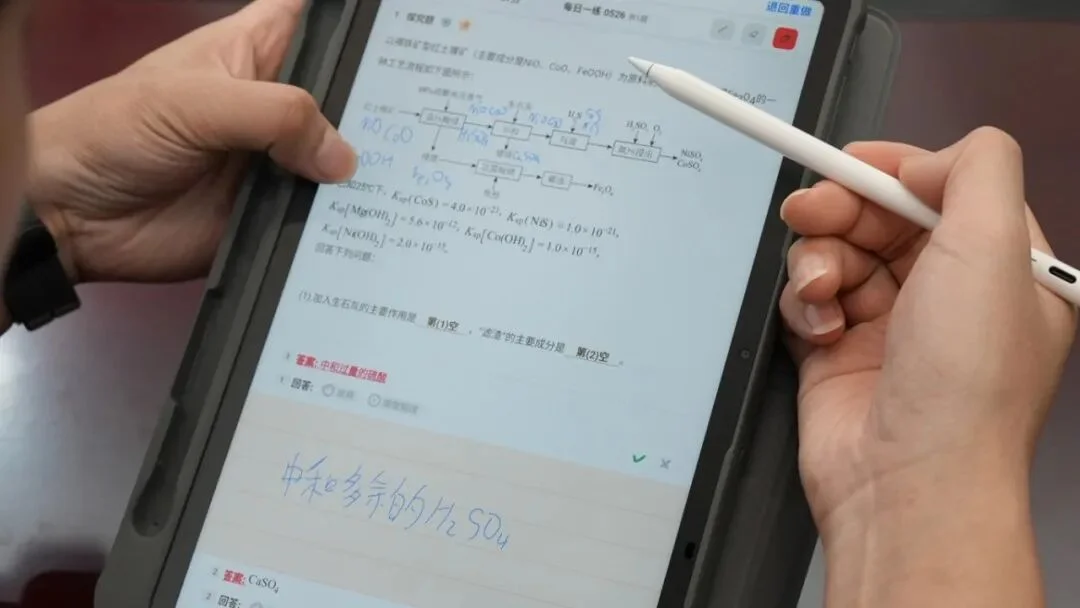
A health check is valuable because it helps identify a problem while something can still be done about it.
Formative assessment works in much the same way.
It gives teachers information early enough to intervene.
This is the practical foundation of adaptive assessment: assessment is not merely measuring learning; it helps shape the next learning decision.
Real-Time Data Changes What Teachers Teach
Geography teacher Chen Jianxia uses classroom response data to decide how much time different questions deserve.
After explaining a topic, she can send a short exercise to students’ devices.
A few minutes later, she can see patterns in their responses.
If only one or two students are incorrect, those students may resolve the problem through peer discussion.
If many students choose the same incorrect option, the class spends more time investigating why.
This is data-driven instruction in a practical sense.
It is not about filling dashboards with numbers.
It is about making better instructional decisions.
Math teacher Cai Mengjiao follows the same logic during review lessons.
Rather than reteaching an entire unit from beginning to end, she can use learning data to identify the concepts students have already mastered and concentrate lesson time on genuine difficulties.
That changes the teacher’s question from:
“What material should I cover today?”
to:
“What do these students need today?”
What Learning Analytics Should Actually Do
As education becomes more digital, schools can collect increasingly large amounts of student information.
But more data does not automatically mean better education.
Useful learning analytics in education should help answer concrete teaching and learning questions.
For example:
Which concepts have most students mastered?
Which wrong answer appears repeatedly?
Which students need foundational reinforcement?
Who is ready for extension?
How long are students spending on particular tasks?
Which mistakes are recurring over time?
Has a student actually mastered a concept after additional practice?
When data cannot influence a learning decision, its educational value is limited.
The goal should therefore be actionable insight rather than maximum data collection.
The Error Notebook Becomes a Learning Tool
Traditional error notebooks can be valuable.
They can also require a surprising amount of time.
A student copies a question, writes the answer again, records the explanation, and then may rarely return to it.
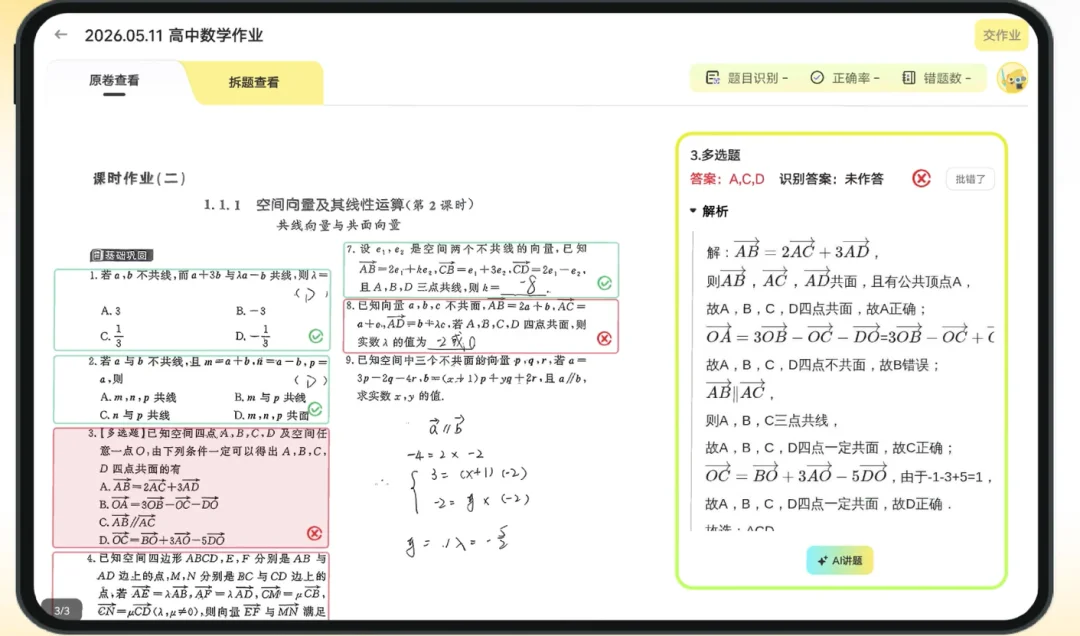
Digital error tracking changes the workflow.
Incorrect questions can be collected automatically.
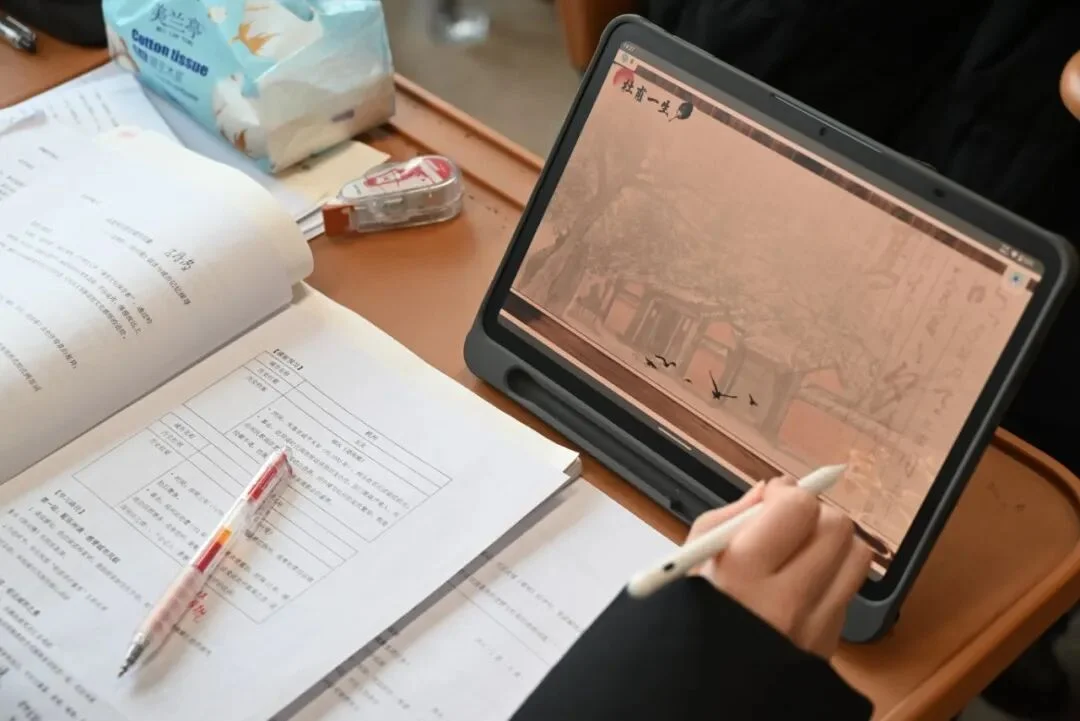
Students can revisit them later.
Questions can be organized by difficulty or frequency of error.
Students can generate targeted review sets and repeat a problem until the underlying concept is understood.
For Tu Chengwei, this removed much of the time previously spent manually copying questions.
For Zhang Yuhan, information about question difficulty and repeated mistakes made review more targeted.
This matters for self-directed learning because students need a usable way to observe their own progress.
Without information, “study harder” is vague advice.
An error record turns it into something more concrete:
These are the concepts I still need to work on.
AI Feedback Should Support Thinking, Not Bypass It
There is an important distinction between AI helping a student learn and AI simply giving a student an answer.
Student Miao Renyi noticed that distinction himself.
When using conventional answer-search tools, seeing the final answer immediately could make it tempting to skip the reasoning and copy the result.
Step-by-step guidance created a different experience.
Instead of starting with the answer, the system could guide him through the process needed to reach it.
This is one of the central design questions for AI in education.
A tool can make schoolwork faster while making learning weaker.
Or it can make feedback faster while preserving the student’s responsibility to think.
The second model is far more valuable.
Good AI support should therefore use prompts, hints, explanations, questions, and staged reasoning to help learners continue their own thinking.
The goal is not:
“Let AI solve this for me.”
It is:
“Help me understand enough to solve this.”
Self-Directed Learning Grows From Repeated Small Decisions
Self-directed learning sounds like a major educational goal.
In practice, it grows through small behaviors.
A student notices a weak area.
The student chooses additional practice.
The student reviews an error without being told.
The student decides to attempt a more difficult problem.
The student previews tomorrow’s lesson because today’s work was completed efficiently.
These actions gradually shift ownership of learning.
English teacher Zheng Suya began to see students actively asking for more targeted work.
Some wanted extra practice because they knew they were weak in a particular area.
Others asked for more challenging exercises because they felt ready to progress.
That is an important transition.
Homework changes from:
“The teacher told me to complete this.”
to:
“I know why I need to practice this.”
Appropriate Challenge Builds Motivation
Student motivation is sometimes treated as something teachers need to add from outside through prizes, pressure, or encouragement.
But the design of learning itself matters.
If homework repeatedly feels impossible, students may associate independent practice with frustration.
If it is always too easy, they may see little value in completing it.
Several students at Zhihe initially noticed that classmates were receiving different assignments.
Over time, however, they became more comfortable with the idea when they recognized that the tasks were designed around their own needs.
One student’s response captures the principle well:
The work that fits you is the work that helps you.
That sense of appropriate challenge can create a positive learning loop:
achievable challenge → effort → success → confidence → greater willingness to try
That cycle is an important foundation for independent learning.
From “Do More” to “Know What to Do Next”
Student Gan Manni provides a useful example.
When homework became more targeted and efficient, she had more time available for pre-class preparation.
Because she previewed learning materials before lessons, she found it easier to follow the teacher’s reasoning and participate during class.
That classroom understanding then made later practice more productive.
The sequence became:
targeted homework → more available time → better preparation → stronger classroom understanding → more effective practice
This shows why personalized practice and self-directed learning are closely connected.
Reducing unnecessary work does not necessarily mean reducing academic rigor.
Sometimes it creates space for more meaningful learning.
Teachers Become Learning Designers
AI-supported assessment also changes teachers’ work.
Automatic marking can reduce the time spent on repetitive tasks.
Learning dashboards can make common errors visible.
Digital explanations can answer recurring questions.
But the most important question is what teachers do with the time they recover.
At Zhihe, teachers use it for individual tutoring, advanced writing support, lesson redesign, analyzing misconceptions, and adjusting future assignments.
In other words, technology takes over some routine processing while teachers move toward work requiring more judgment.
This echoes Hailiang’s wider work around AI for teachers.
The teacher’s value does not decrease when information becomes easier to obtain.
Professional judgment becomes more important because someone still needs to decide what the information means.
The Limits of AI Formative Assessment
Responsible use also requires recognizing what learning data cannot tell us.
A correct answer does not always prove deep understanding.
A slow response does not necessarily mean weak ability.
A student’s performance may be influenced by language, confidence, fatigue, motivation, or other factors.
AI-generated explanations can also be incomplete or incorrect.
For these reasons, automated results should support—not replace—teacher observation and professional judgment.
Schools also need clear policies for student data, appropriate use, age suitability, and human oversight.
The goal of AI formative assessment should be better decisions, not automated decisions.
What Should International Families Ask Schools?
Families comparing education options in China can learn a great deal by asking how a school uses assessment.
Instead of only asking about examinations, consider asking:
How often do students receive feedback?
Feedback is most useful while students still have an opportunity to act on it.
Can students see and understand their own learning gaps?
Self-directed learning requires access to understandable information about progress.
What happens after a student answers incorrectly?
A good system should lead toward explanation, practice, or teacher support—not simply display a red mark.
Does AI show students answers or help them think?
The distinction is crucial.
How is teacher judgment included?
Teachers should retain responsibility for educational decisions.
Does technology make students more independent over time?
That may be the most important question of all.
International families who want to understand HIS more broadly can explore About HIS or contact the school’s international admissions team for information about learning pathways and student support.
The Best Learning System Gradually Makes Students Less Dependent on It
There is a paradox at the heart of educational technology.
A good learning system provides students with more support.
But the ultimate purpose of that support should be to help students need less external direction over time.
Formative assessment makes understanding visible.
Learning analytics helps identify what needs attention.
AI can make feedback more immediate.
Teachers turn that information into meaningful learning decisions.
Students gradually learn to recognize gaps, select strategies, seek appropriate challenge, and review their own progress.
That is where technology becomes educationally valuable.
The final goal is not a student who is excellent at following an AI system.
It is a student who increasingly knows how to learn.
Frequently Asked Questions
What is formative assessment?
Formative assessment is assessment used during the learning process to identify current understanding and determine what teachers or students should do next. It is primarily intended to improve learning rather than simply produce a final grade.
What is self-directed learning?
Self-directed learning is a process in which learners increasingly take responsibility for identifying their learning needs, choosing strategies, using resources, monitoring progress, and evaluating what they have learned.
How does formative assessment support self-directed learning?
Formative assessment gives students information about what they understand and where gaps remain. When students can use that information to select practice, review mistakes, seek support, or adjust strategies, they become more active participants in their own learning.
What is data-driven instruction?
Data-driven instruction means using evidence from student learning to inform teaching decisions. This can include assessment results, classroom responses, error patterns, task completion, and other indicators of student understanding.
What are learning analytics in education?
Learning analytics involves collecting and interpreting learning-related data to understand student progress and improve educational decisions. Useful analytics should lead to specific actions rather than simply generate more statistics.
How can AI be used for formative assessment?
AI can assist with question generation, automatic marking, pattern detection, personalized feedback, targeted practice, and identifying potential learning gaps. Teacher oversight remains necessary.
Can AI help students become independent learners?
Yes, if AI is designed to provide guidance rather than replace thinking. Hints, feedback, progress information, error review, and targeted practice can support independence, while systems that simply provide answers may increase dependence.
What is the difference between formative and summative assessment?
Formative assessment is primarily used to improve learning while it is taking place. Summative assessment typically evaluates learning at the end of a unit, course, or defined period.
Is AI feedback better than teacher feedback?
They serve different purposes. AI can provide rapid and scalable feedback, while teachers contribute context, professional judgment, motivation, relationships, and a deeper understanding of the individual learner. The strongest approach combines both appropriately.
What should parents ask about AI when choosing a school in China?
Parents should ask how AI is used in actual lessons, whether teachers review AI-generated recommendations, how student data is handled, whether AI supports rather than replaces thinking, and how technology contributes to student independence.