


AI Transforms Education: Digging Deep Into “Slow Is Fast”
 2026.4.30
In the spring of 2026, in a biology classroom at Zhejiang Hailiang Experimental High School, there was no one at the lectern.
Teacher Xu Qiang had stepped to the back row of the classroom and was staring at the tablet in his hand. On the screen, the progress of each group through the challenges kept updating. He had turned the process of protein synthesis into a game called “Treat Little Q.” Students worked in “medical teams”: some looked through materials to find passwords, some deduced amino acid sequences, and some were responsible for recording diagnostic reports. Xu Qiang only walked over and asked a few questions when the students got stuck.
When the bell rang, one group leader stared at the screen, still wanting more: “So this is how ribosomes work.”
This scene is just one of many slices now taking place on this campus.
Outside this classroom, the “Star Cube” smart class sign in the hallway is running silently: attendance, timetables, substitute-teaching approvals, and 18 campus scenarios are connected by a single screen. In the teacher’s office, the AI classroom advisor has already broken down the class that just ended into two parts: “done well” and “needs improvement.” In the evening, Ms. Li, a parent, sees snapshots of her child doing experiments on “Hi Home-School” and leaves a comment: “I never knew cell division could be this romantic.”
Classrooms, corridors, offices, families–AI is no longer just a screen hanging on the wall. It has become a “nervous system” that seeps into every corner of the campus. And the operator behind all this is a company called Hailiang Technology Services.
From entering the field in 2021 to being selected as a Zhejiang unicorn company in 2026, it has become the first education technology unicorn in China focused on empowering schools. In just a few years, its services have covered 210 districts and counties and more than ten million service instances, and its revenue last calendar year exceeded 1 billion yuan.
But compared with its expansion in scale, what deserves more attention is the angle from which it entered the market.
When peers were competing for orders from famous schools in first- and second-tier cities and selling hardware by stacking computing power, Hailiang Technology Services did two “unusual” things.
First, it dug deep into county-level markets and “the bottom 30% of schools in China.” Second, it did not become a general player that first develops technology and then looks for use cases. Instead, relying on the parent company’s 30-year history of running schools, it went all in on scenarios and plunged into the deepest vortex of classroom reform.
How did this decision, which seemed “laborious and unrewarding,” allow it, five years later, to become one of the few unicorns in the education AI track to complete a scalable closed loop?
Digging Deep Into “the Hardest Thing”: How Does AI Reconstruct the Classroom?
“If we are going to do something, we should do the hardest thing. If we are going to change something, we should change the 99% of classrooms that are still teacher-dominated lectures.”
Sitting in his office, Chen Junwei, chairman of Hailiang Technology Services, recalled the starting point of last year’s decision. Education informatization has entered the 2.0 era, and policy tailwinds are blowing strongly. But the real picture inside schools left him deeply troubled.
Chen Junwei visited Hailiang’s schools and also went to county-level areas for research. What he saw was highly consistent: teachers sweating as they lectured for 45 minutes, while students grew drowsy. Even if classrooms had been equipped with all-in-one machines and homework grading software, the underlying logic of the classroom was still the “standardized infusion” of the industrial age.
“A student spends more than 80% of his or her time in the classroom. If the classroom does not change, all technology investment is just icing on the cake.” He gave his team a hard order: focus on the classroom. That is the “key lever” of school transformation.
But that is easier said than done. The classroom is the most complex “micro-battlefield” in education: it involves the entire chain from pre-class preparation to in-class interaction and after-class evaluation, and it involves multi-role interactions among teachers of different subjects and dozens of students with very different personalities.
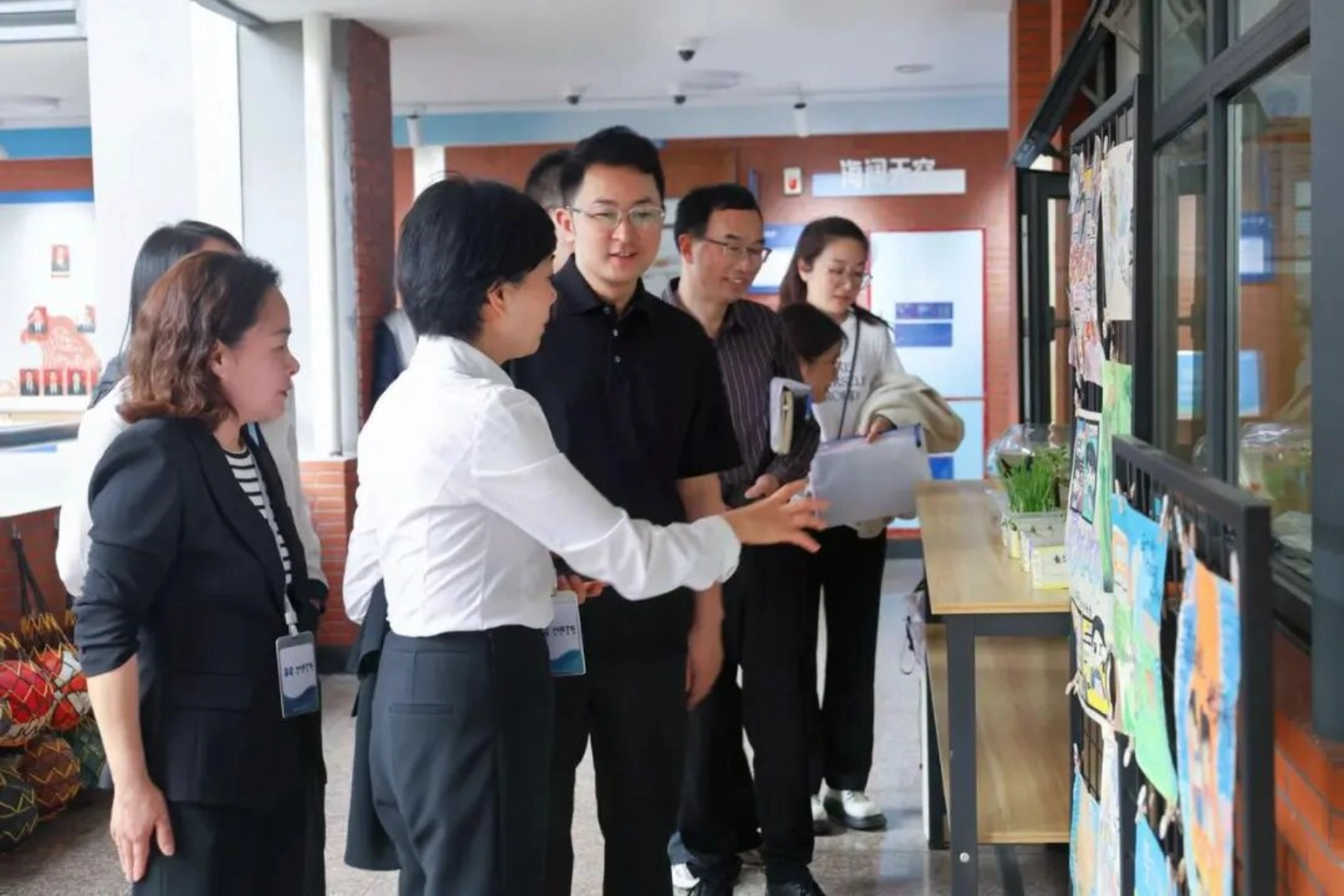
Chen Junwei gathered principals, management teams, and technical staff for discussions, and everyone’s reaction was surprisingly consistent: “This is great, but it is too difficult.”
But “difficulty” is exactly the moat in his eyes. “The hardest things are often also the simplest, because few people do them. As long as you keep putting resources into them, the barriers will naturally become higher and higher.”
How should it be changed? Chen Junwei already had a mature methodology called “best practices,” which originated in 2019.
When they had just begun to get involved in education technology, they dissected a famous school. The secret of that school’s performance management was this: teachers of different subjects did not compete with one another for time, because the performance model treated the future grades of the whole class as a “total pie” distributed to the homeroom teacher and teachers of all subjects, forcing teachers to form synergy.
Hailiang Technology Services spent a long time refining these experience-based processes into a digital tool called “Hailiang Class Wisdom.” It then co-created the tool with its own principals and teachers, focusing on “borderline students,” the group most likely to show results–students who might fall out of key-university eligibility if they drop 10 points, or break into it if they rise 10 points–as the core lever of performance evaluation. After launch, the first trial was a success.
This research-and-development logic, “born on campus and growing on campus,” has been used to this day: first identify the best practices in the scenario, use technology to build tools well, then co-create with principals and teachers, pilot in classes, and quickly expand after results appear.
This deep understanding of scenarios eventually gave rise to Hailiang Technology Services’ latest AI classroom transformation solution–the “AI Creative Thinking Classroom.”
Since 2025, the “AI Creative Thinking Classroom” has been running as a regular practice in more than 100 schools.
Interestingly, after Chen Junwei personally became head of the curriculum reform group, he chose to start with schools whose academic-subject performance was weak but whose room for improvement was also large.
At Hailiang Art High School, AI transformation solved the pain point of art students’ weak academic courses. The classroom was turned into a growth game involving everyone: students independently elected group leaders, and under the “Star Power” points system, speaking up, providing service, and winning awards could all be converted into points that could be exchanged for milk tea, privileges to go out, and even unlocking a group hotpot meal.
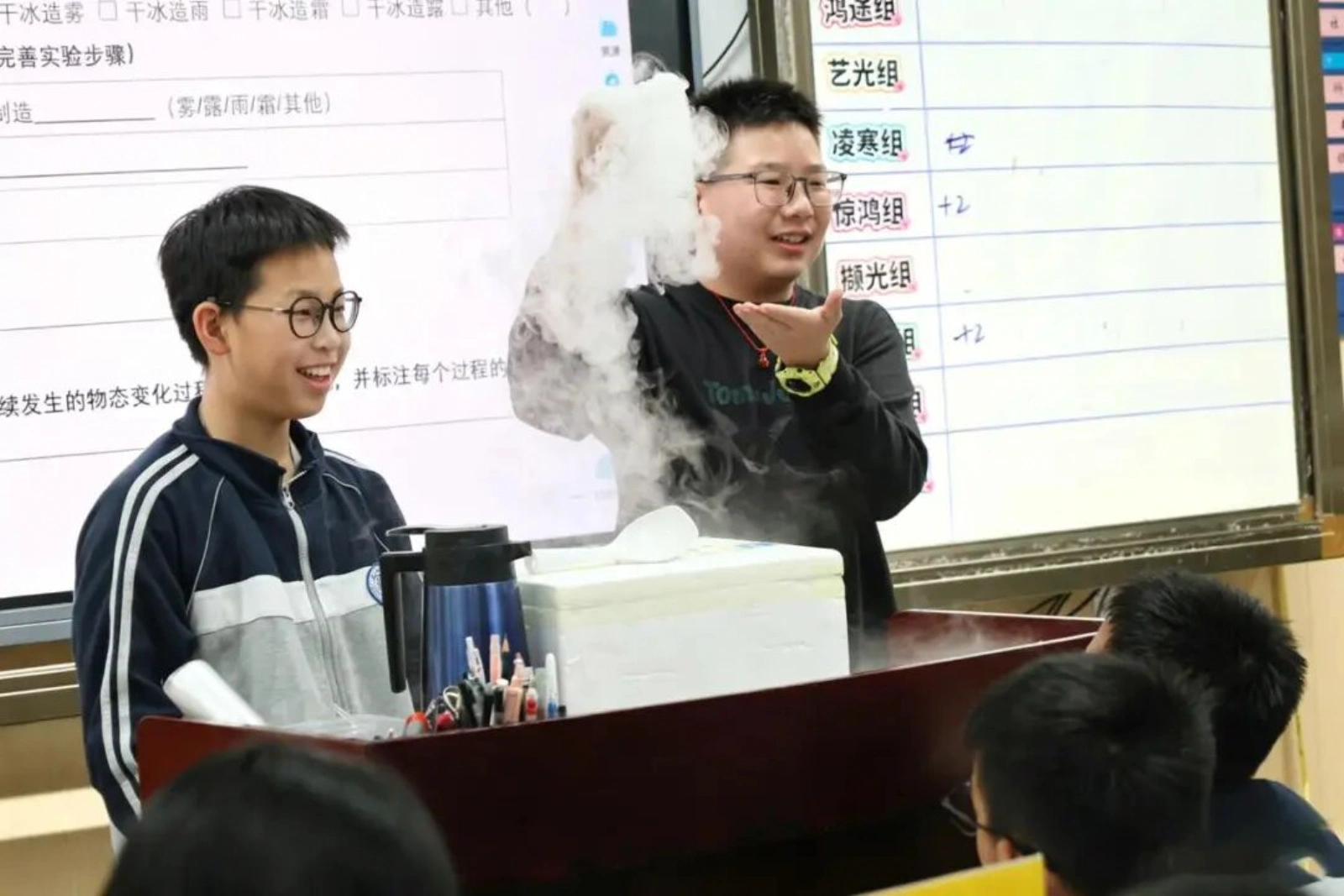
At Hailiang Junior High School, the protagonists at the lectern became rotating “little teachers.” Teachers are no longer obsessed with “how to explain clearly,” but stand in the back row to ask follow-up questions and guide students. The core of this model is the “Three-Teacher Classroom”: the initiative in learning is returned to students, teachers are responsible for design and guidance, and AI teaching assistants provide precise feedback.
These different classroom models are all based on an integrated intelligent teaching terminal of software and hardware, building a full-process support system of “data collection–intelligent analysis–precise feedback.”
Its working logic runs through the three major stages of before class, during class, and after class.
Before class, the system pushes preview resources, and students complete guided-learning sheets that generate learning-condition data, shifting lesson preparation from “based on experience” to “based on data.” During class, intelligent terminals capture participation and answer quality in real time. After class, personalized tutoring paths are generated based on wrong-answer data. A closed loop of “teaching–evaluation–optimization” is thus formed.
Data show that in schools where it runs regularly, teachers’ average lecture time has fallen from “lecturing for the whole class” to about 15 minutes, while students’ classroom participation and teacher-student relationships have improved significantly. In terms of grades, 70% of students have improved, and 30% have remained stable.
But Chen Junwei emphasizes that score improvement is only the surface. What the AI Creative Thinking Classroom solves is a deeper issue–it centers on human growth, rather than simply pursuing scores.
In his view, this model simultaneously solves three core variables in student development: the time variable–the time spent learning is just right for the student; the personalization variable–it solves each student’s individual problems; and the emotional variable–that is, intrinsic motivation, whether the student wants to learn. These three elements are almost impossible to achieve at the same time in a traditional classroom.
More importantly, it points to the future. Chen Junwei’s judgment is that the purpose of education is to cultivate people for the future. In the era of artificial intelligence, students need four core competencies: human-machine collaboration, higher-order critical thinking, empathy, and self-awareness.
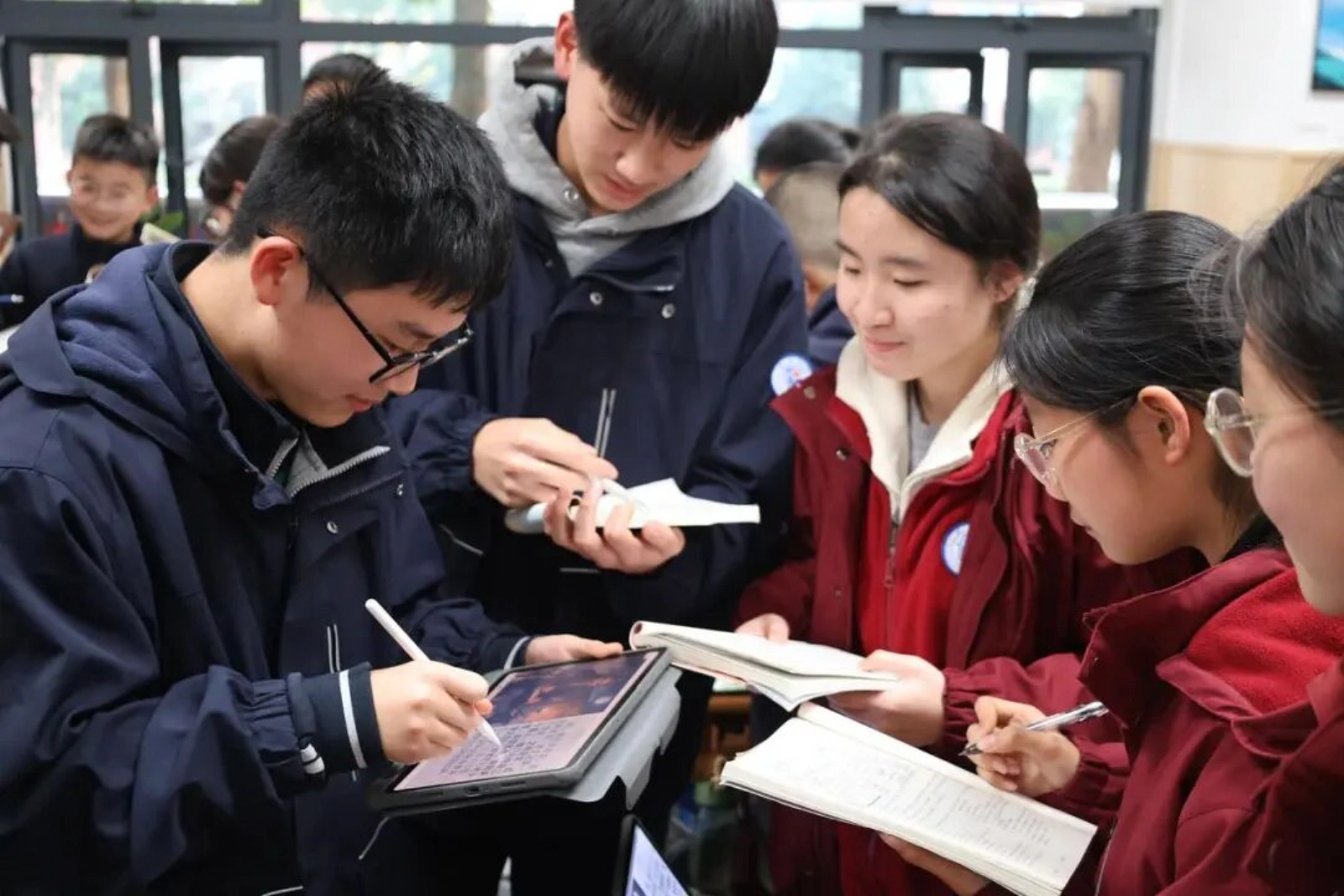
The design of the AI Creative Thinking Classroom fully considers these issues. Cooperative learning helps students learn empathy; independent learning and AI question-and-answer exploration address human-machine collaboration; and discussions of open-ended questions strengthen critical-thinking training.
The AI Creative Thinking Classroom is only one entry point for Hailiang Technology Services.
In Chen Junwei’s view, “Our summary of individualized teaching is just two sentences: when others have it, we do it better; when others do not have it, we have it.”
“When others have it, we do it better” means understanding scenarios better than peers and fitting schools better.
In addition to classroom teaching, Hailiang Technology Services has also launched a series of products in scenarios such as smart student development, smart teacher training, smart governance, and smart campuses. For example, “Star Future” targets the pain point in five-dimensional education evaluation, where there is “form but no substance,” while “Star Oasis” provides a systematic mental health intervention process.
But these are not the most core differences.
There are many companies in the market that talk about “individualized teaching,” but most of them are actually doing “precision teaching”–pushing content according to students’ knowledge mastery and ability progress. Hailiang Technology Services differs in that its thinking about teaching scenarios runs through the full process before class, during class, and after class. What it does is more scenario-based and better suited to the real rhythm of schools, and it has long focused on personalized growth.
“When others do not have it, we have it” means creating more intelligent supporting tools.
A typical example is the self-developed “AI Classroom Advisor.” After a teacher finishes a class, the system automatically generates a complete classroom analysis report–from teaching objectives and content presentation to teacher-student interaction, it precisely breaks down what was taught well and what needs improvement. Teachers no longer need to rely on vague memory for review; as soon as class ends, they can obtain a basis for reflection.
This capability is continuing to move downward. They are also advancing an “AI Student Classroom Advisor.” For segments such as little teacher explanations and group discussions, AI evaluates the quality of students’ questions, their expression ability, and the depth of their thinking, helping students see their own growth. These products are not available on the market, yet the demand grew out of classroom reform itself.
The classroom problem now has an answer. But the next question follows immediately: who needs this solution the most?
Why Are County-Level Schools the Best Practice Ground?
Holding a polished “weapon” in hand, Chen Junwei aimed it at the most “barren” battlefield–China’s county-level areas and the bottom 30% of schools.
This choice was half emotional and half rational.
Emotionally, Chen Junwei came from the countryside and deeply understands the pain of county-level education–structural shortages of high-quality teachers, outdated teaching concepts, continuous loss of students, and insufficient high-quality educational resources. Simple and easy-to-use AI tools can, to some extent, fill this gap.
Rationally, he discovered that county-level areas are a “blue ocean” overlooked by giants.
He summarized the practical advantages of county-level schools: high decision-making efficiency, an extremely strong willingness to change, and no dependence on successful past paths, so they are willing to try with full commitment.
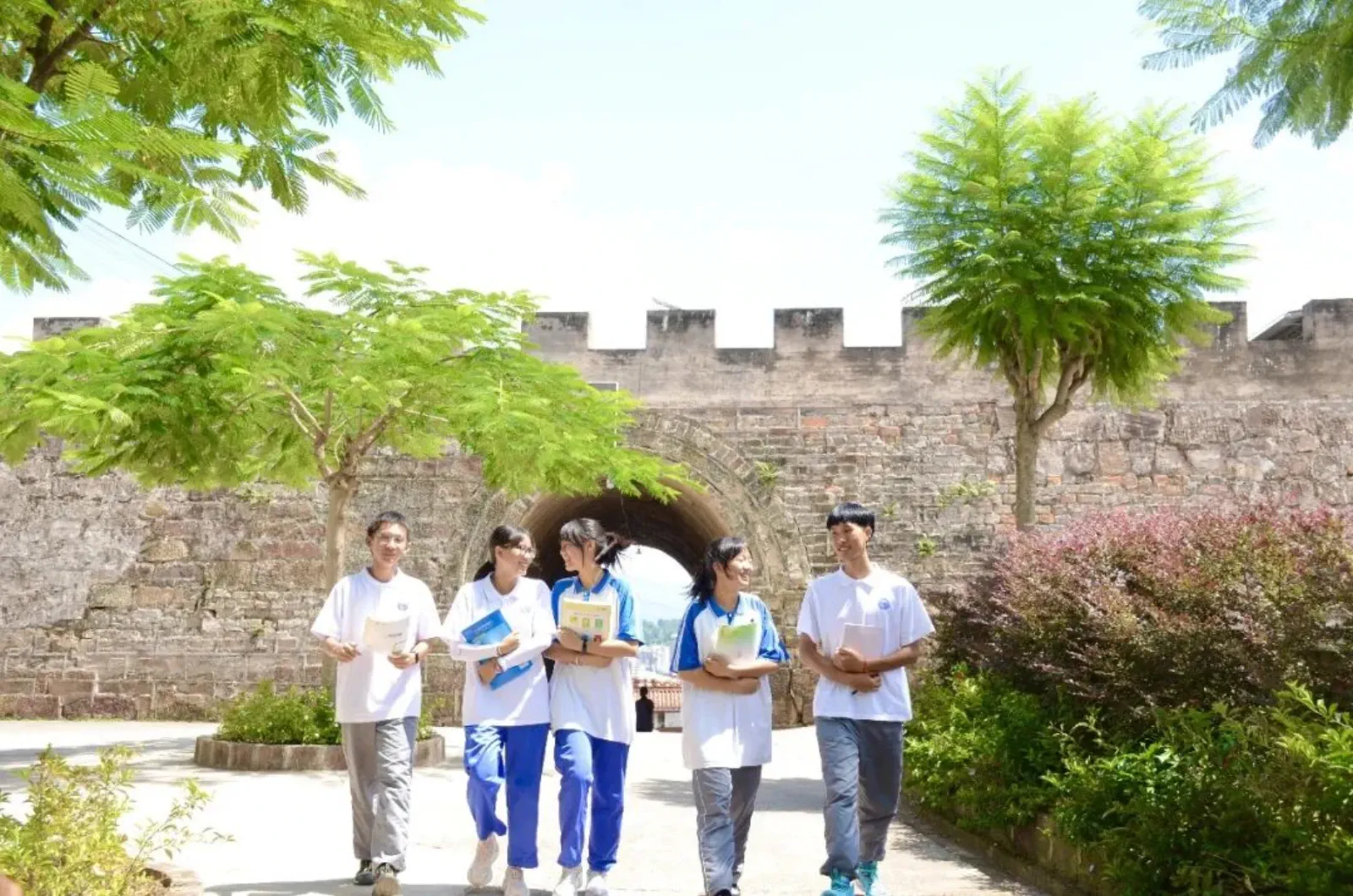
So when most education technology companies focused on first- and second-tier cities, Hailiang Technology Services plunged into lower-tier cities.
But having a battlefield was not enough. Making B-end schools willing to pay and making the solution replicable at scale were the real tests.
Hailiang Technology Services follows a distinctive G-B-C path: it wins the favor and trust of government and B-end clients through professional services and real results, and builds a student-centered resource allocation system, giving rise to and meeting students’ diversified C-end educational needs.
But this path places extremely high demands on a vendor’s “ability to converse” and “ability to deliver.” Hailiang Technology Services has managed to break through because it has worked hard to fill the shortcomings in market supply.
What schools need is not exactly a set of isolated AI software tools, but a set of certain outcomes from diagnosis and consulting to implementation.
With 30 years of experience running schools, Hailiang Technology Services can provide a complete set of services from problem diagnosis, top-level consulting, and stationed teams to teacher training and student growth. It has now covered more than 200 districts and counties in 30 provinces and municipalities across China, supported by a large frontline service team.
Even more importantly, Hailiang Technology Services dares to commit to quantitative indicators.
Chen Junwei requires the team to actively agree with local governments on measurable outcome indicators, such as the extent of improvement in teaching performance and the degree of improvement in teaching-research efficiency. Because there is a commitment, the team must dig deep into results during implementation. Once results emerge, the trust relationship becomes solid, and repeat purchases and additional purchases naturally follow.
These products and services that dare to promise results are exactly the biggest supply shortcoming in today’s smart education market.
At the same time, Hailiang Technology Services maintains an open attitude. If a single product on the market is good, it integrates it, provided that it can be incorporated into its own system and connected to its data foundation.
In Jingdong Yi Autonomous County in Yunnan, when Hailiang Technology Services took over Jingdong No. 1 High School in 2021, almost all students in the county who scored above 500 on the senior high school entrance examination were leaving. Through consulting services, classroom transformation implementation, and stratified teaching, three years later, the number of students from this school admitted to undergraduate programs exceeded 177, and high-quality student sources returned on a large scale.
At Ansai District Senior High School in Yanan, Shaanxi Province, in the first year after Hailiang Technology Services entered, the number of students admitted to first-tier universities rose from 45 to more than 100, and the number admitted to Double First-Class universities exceeded the school’s total for the previous five years. By 2025, 250 students had passed the special-admission control line, and 911 had reached the undergraduate admission line. It took only three years to achieve this result.
Similar scripts have repeatedly played out at Luxi No. 1 High School in Yunnan, Liancheng Middle School in Mengyin, Shandong, Wushan No. 2 High School in Chongqing, and other schools.
Chen Junwei mentioned that local governments had sent 129 stamped letters of thanks, and the renewal rate had remained stable at above 80%. “When the Hailiang Technology Services team goes to a place, it has to put down roots and turn it into a model. Once the model is established, neighboring districts and counties naturally come to visit, and clients take the initiative to recommend us. From one point radiating into a whole area, a positive cycle of slow is fast is formed.”
The problem of scalable replication was also solved. In practice, their team found that 90% of the core problems in primary and secondary schools across China are common. They adopted a “standard foundation plus modular customization” strategy–every time they entered a new region, they turned special requirements into independent modules. After running in enough counties, they could basically cover the vast majority of scenarios.
“We chose the right battlefield,” Chen Junwei sighed. “County-level areas are the best base for building barriers.”
Vertical Large Models + Scenario-Based Consumption: Hailiang Technology Services Second Growth Curve
Classroom transformation solves the question of “how to learn.” But Chen Junwei looks further: what do students really need?
The core contradiction in China’s current education system is the “contradiction between scaled education and personalized cultivation.”
The new gaokao reform has moved career planning forward to the first year of high school, and even the Outline for Building China into a Leading Country in Education (2024-2035) clearly requires that “primary and secondary schools carry out career enlightenment education.”
The policy direction is very clear: the education system is shifting from “single-track” to “diverse,” and from “unified” to “differentiated.” This means that students’ education planning must be personalized, and schools’ operating models must become distinctive.
Demand is exploding, but supply is lagging. Career planning products used by parents and students on the market roughly fall into two categories: one is general, large-model wrappers that give ambiguous suggestions after a couple of questions, better than nothing; the other is manual consulting by traditional institutions, which relies heavily on experts, is expensive, and is difficult to scale.
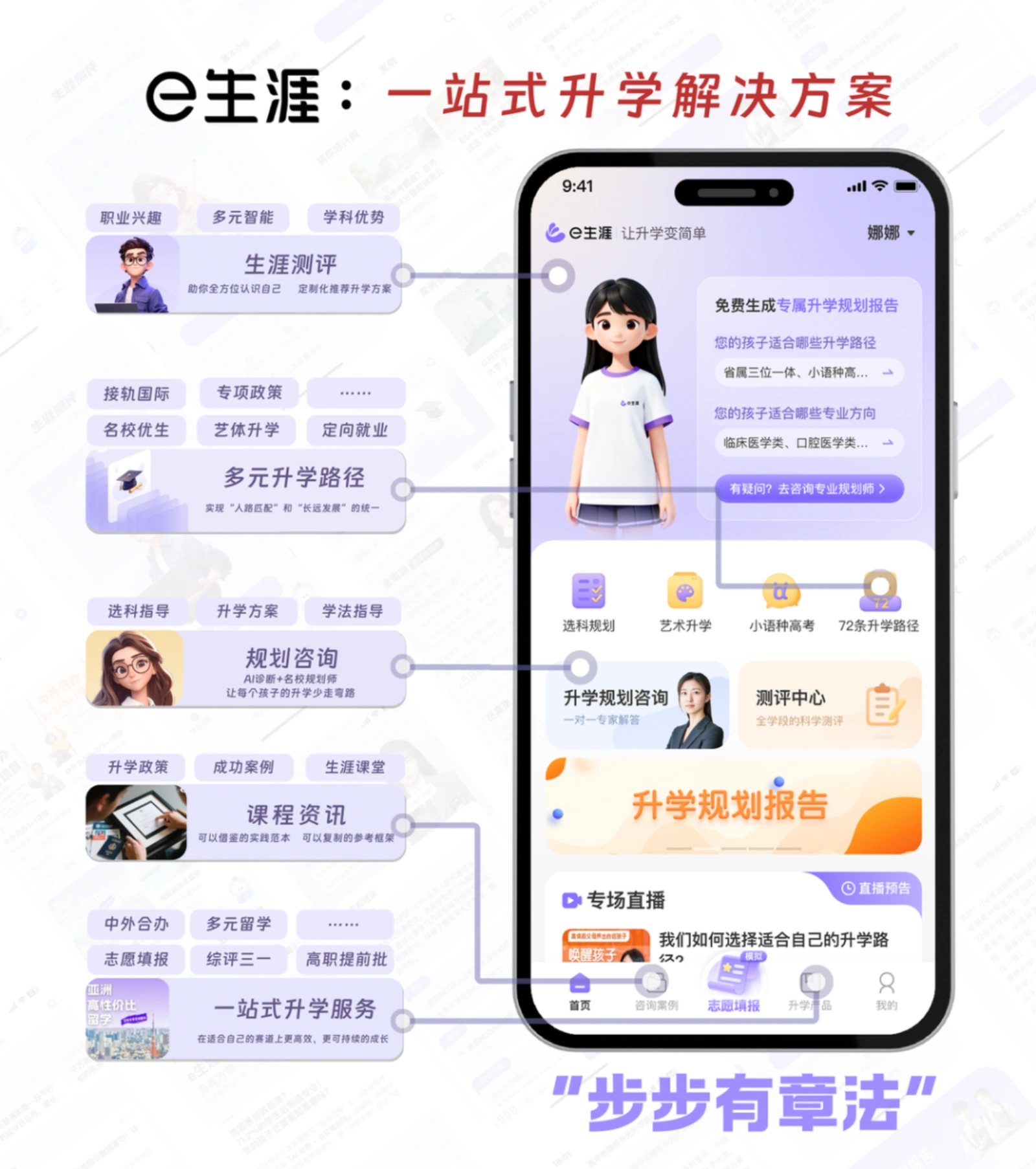
Hailiang Technology Services saw the gap and built a career digital-intelligence platform based on a vertical large model–“e-Career.”
The core difference starts with the knowledge base. General large models are fed “crawler corpora”; “e-Career” is fed real student data. Hailiang Technology Services has accumulated the growth trajectories of hundreds of thousands of Hailiang Education students and extracted a complete pathway map for progression from primary school through junior and senior high school. Combined with authoritative data interfaces from examination authorities and university admissions offices, and calibrated by a team of professional planners, its suggestions are traceable and explainable–unlike general large models, which may give different answers to the same question twice.
The interaction method is also evolving.
The “e-Career” app is currently shifting from “one-way report output” to multi-round conversational iteration. Chen Junwei admitted frankly that although the previous version had a good conversion rate, it was essentially still a tool of the “information age”-the system gave conclusions, and users passively received them. The ideal form he wants is for parents and students to engage in multiple rounds of dialogue with the large model, gradually understand themselves and reach consensus through the dialogue, and eventually naturally derive a suitable path. The team plans to launch a new version based on conversational deep interaction by the end of the year.
But the real barrier to “e-Career” is not dialogue. It is a delivery.
A large model gives suggestions. “e-Career” provides a closed loop of “planning–resources–implementation.” After planning, the platform directly matches corresponding personalized growth services–science and innovation, arts and sports, humanities, international education, and more. Some are self-operated, while more come from a carefully selected third-party ecosystem.
“What we sell is not a query tool, but a solution that helps children find a suitable path and truly follow it through,” Chen Junwei said.
In fact, the whole career technology segment, when combined, looks very much like a composite model. The AI capability layer is similar to a vertical large model providing intelligent decision support, even connecting to a consumption closed loop, somewhat like “Qianwen” and “Taobao.” The resources and services layer is more like JD.com–with both self-operated high-quality services and an open third-party ecosystem, while exercising strict quality control over the supply side.
At present, “e-Career” has carried out app pilots in about 70 schools, converting 100,000 registered users in total, with about 60,000 completing in-depth assessments, and order conversion has far exceeded expectations.
Behind this product, Chen Junwei has a deeper logic: career planning must be done “horizontally and vertically.”
Horizontally, it connects inside and outside the school. Inside the school, it matches students with courses and resources based on data models. Outside the school, it connects students and parents with social education services across various specialized directions.
Vertically, it follows students’ growth–from education planning to major selection and career development, and ultimately extends to lifelong learning.
This is a route map that starts in middle school and runs through an entire life. Horizontally, it breaks down resource barriers; vertically, it penetrates the time cycle.
At this point, the synergy between the entire career technology segment and smart education also emerges.
Looking at the two business lines together, a clear business model has already taken shape: with 30 years of school-running experience as the foundation, smart education serves the B-end and builds trust, while career technology serves the C-end and connects educational consumption. A growth flywheel of “deep cultivation on the B-end + natural growth on the C-end” is taking shape.
Overall, on the government and B-end, Hailiang Technology Services builds government trust and school reputation through classroom transformation and regional service platforms. On the C-end, using the trust accumulated from the government, and on the B-end, it precisely matches demand through a vertical large model and uses services to meet students’ diversified needs, thereby completing commercial monetization. The data assets accumulated on the C-end then feed back into and strengthen the personalization capabilities of the smart education platform.
This model is almost impossible to find elsewhere in China’s education technology track.
Players in the current track roughly fall into two categories. One is hardware manufacturers, which sell all-in-one machines and smart classroom solutions, and target education informatization infrastructure budgets. The other is general large-model vendors, which use AI capabilities to build content-generation and question-answering tools and target teaching-assistance scenarios.
Hailiang Technology Services occupies a special position. It does not belong to either of the above categories, but it overlaps with the core areas of each.
Compared with hardware manufacturers, it has scenario depth and its own schools to create a data closed loop, combined with deep services, so product usage is far higher than the procurement model where equipment is installed and then left to gather dust. Compared with general large-model vendors, it has a school-running data foundation, will not give ambiguous suggestions, and has a full chain of “decision-making–resources–delivery,” forming entry barriers that competitors cannot replicate in the short term.
The room for imagination corresponding to this position far exceeds the valuation logic of a software company or a service company.
According to estimates in the 2025 Research Report on Digital-Intelligent Education Information Technology Application Innovation by Xinchuang Consulting, the size of China’s digital-intelligent education market in 2025 is about 646.4 billion yuan and is expected to exceed 900 billion yuan by 2030. Ministry of Education data show that by the end of 2024, China had 15,000 regular senior high schools, 52,000 junior high schools, and 136,000 primary schools, with 189 million primary and secondary school students enrolled.
What Hailiang Technology Services targets is the overlooked but massive base of this huge market–the bottom 30% of schools. The pain points are deep, supply is scarce, and once a scalable path is proven, every percentage-point increase in penetration will release revenue on an exponential scale.
The flywheel has only just started.
This is a “slow business.” It requires deep cultivation and trust, and results need time to be verified. But once barriers are built, slowness becomes the strongest moat.
Looking back, what Chen Junwei has led Hailiang Technology Services to explore over the past few years is actually the same thing: in places where the industry has a collective blind spot, find the truly important problem, then dig deep and iterate step by step.
When the industry was chasing computing power, he chose to plunge into classroom scenarios, because “if the classroom does not change, all technology investment is just icing on the cake.” When the industry was competing for orders from famous schools, he chose to dig deep into county-level areas, because “the bottom 30% of schools in China are the foundation of educational equity.” When the industry was making “score-improvement tools,” he chose to build “life pathways,” because “what students really need is not a few more points, but to find a direction that suits them.”
Three reverse choices, three early positions. Chen Junwei never chases trends. He simply asks the same question again and again: “What exactly is education missing?” People who have run schools have an instinct for this question.
And commercial returns are often hidden behind those truly important questions that most people choose to avoid. In education, commercial value and social value have never been opposites. Products that can truly solve social pain points naturally have the strongest commercial barriers.
Having reached this point, Chen Junwei finally dares to say that he has turned the hardest thing into the simplest thing. He also believes that the AI era has provided an excellent opportunity: “With AI as a new driving force, there is an opportunity to replicate and upgrade best practices on a large scale, while also establishing higher barriers.”
By Jide
Edited by Ziye