


Study in China: A Graduate Sees School From the Other Side
 2026.7.20
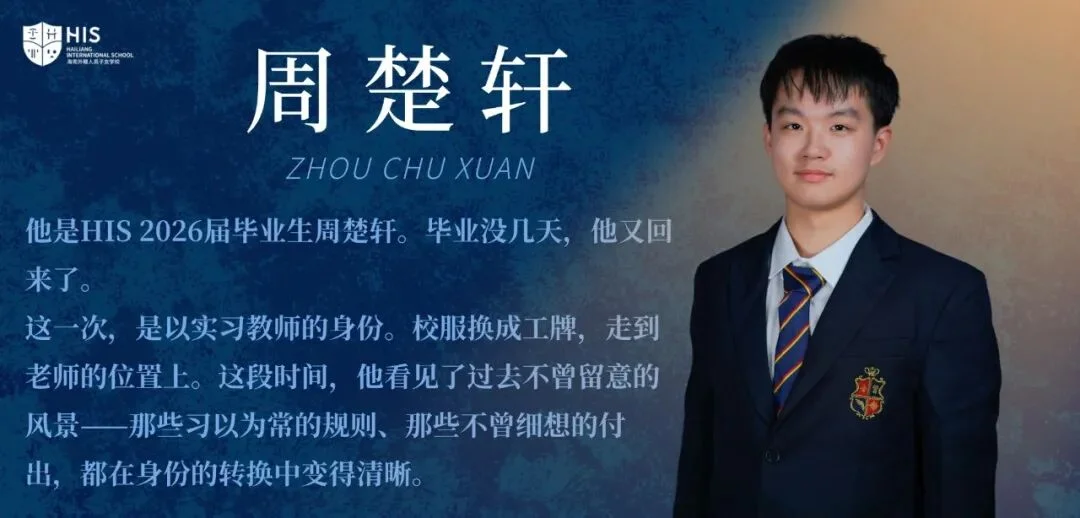
Many students and parents wonder what it is really like to study in China at a high school and search for honest accounts of student life at a high school in China. Zhou Chuxuan, a member of the HIS Class of 2026, gained an unusual perspective shortly after graduation: he returned to the same campus, not in a school uniform, but with a staff badge.
His experience did not simply bring back memories. It changed the way he understood teachers, school rules, student support, and the unseen work that keeps a school running.
Returning to HIS in a New Role
Zhou transferred to HIS during his final year of high school. Because he had only one year to prepare for graduation, his days passed quickly.
He was busy catching up academically, adapting to new classmates and following a demanding schedule. At the time, he did not feel that he had developed a particularly deep emotional connection with the school.
Returning after graduation therefore felt like completing a lesson he had missed.
The campus was familiar, but his role had changed. Instead of rushing from class to class, he was now helping teachers prepare materials, organize activities, move supplies and support younger students.
For the first time, he could see school life from the other side.
The Work Students Do Not Usually See
During his final year, Zhou often felt that students had a more difficult schedule. They attended classes, completed assignments, prepared for examinations and tried to manage every hour carefully.
Teachers, from a student’s perspective, appeared to finish a lesson and move on.
His short period working at the school challenged that assumption.
He discovered that some teachers arrived before 8:00 a.m. and remained on campus until after 10:00 p.m., particularly when they were responsible for evening study or checking student dormitories.
Teaching was only one part of their day. Their responsibilities also included:
- Preparing lessons and presentations
- Marking assignments
- Attending meetings
- Answering questions from parents
- Managing unexpected student issues
- Organizing school activities
- Producing documents, photographs and videos
On one occasion, Zhou spent almost an hour helping a teacher print a large set of materials. Surprised by the amount of work, he commented on how many pages there were.
The teacher smiled and explained that students might see only a few pages, while teachers carried “an entire mountain” behind them.
That sentence stayed with him.
Tasks that once appeared effortless—designing a presentation, formatting a document, organizing a spreadsheet or editing a video—required knowledge, practice and time. Teachers had developed these abilities because the school community depended on them.
Understanding the Weight Behind School Activities
Zhou also helped teachers move supplies and prepare for school programs.
Initially, he thought of this as simple physical work. Then he saw a teacher carrying several large boxes down a corridor. The boxes were stacked so high that they almost covered her face, yet she walked steadily, as though this were an ordinary part of her day.
That moment helped him understand how much invisible labor supports every visible school activity.
Classroom decorations, summer programs, student events and daily campus operations do not happen automatically. Someone plans them, prepares the materials, carries the equipment and solves the problems that appear along the way.
While assisting with a summer camp, Zhou experienced another side of the work. Being surrounded by students for an entire day required constant attention and emotional energy.
Even when his voice became tired, he still needed to speak patiently. Even when he felt exhausted, he had to remain positive and engaged.
He began to understand that teachers often protect students from the heaviest parts of the work. Students see the completed activity, the organized classroom or the calm response to a problem. They may not see the physical effort, emotional pressure, and preparation behind it.
Why School Rules Exist
As a student, Zhou had questioned many school rules.
Why could students not use their phones during lessons? Why did they have to wear uniforms? Why was lateness recorded?
After spending time with staff responsible for student development and campus discipline, he began to see the purpose behind these expectations.
Rules were not simply designed to control students. At their best, they created a predictable environment in which everyone could learn and live safely.
Clear expectations helped protect:
- Student safety
- Classroom concentration
- Respect between community members
- Fairness and consistency
- The orderly use of shared spaces
For students planning to study in China, school rules may initially feel unfamiliar or more structured than expected. Understanding the purpose behind them can make adaptation easier.
A well-explained rule is not only a restriction. It can also be a form of support.
The Moment a Student Finally Understands
One evening, Zhou helped a younger student prepare for an academic assessment.
He explained the same problem several times, but the student continued to look confused. Rather than becoming impatient, Zhou slowed down and tried again.
Eventually, the student looked up and said, “I think I understand it now.”
That small moment changed Zhou’s understanding of teaching.
A teacher’s responsibility is not merely to finish presenting information. The real goal is to recognize whether a student feels lost, discouraged or ready to progress—and then find a way to reach that student.
Teaching may begin with knowledge, but education depends on attention.
Teachers are constantly observing what students may not say directly:
- A student who seems unusually quiet
- A student who has recently become more confident
- A student who is struggling to adapt
- A student who needs encouragement rather than criticism
- A student who is ready for a new challenge
To educate a student is, in part, to see that student clearly.
Seeing the Campus Differently
Standing in the corridor, Zhou watched younger students hurry to class, talk with friends, and laugh as they passed.
They reminded him of his own classmates.
As a student, he rarely considered what teachers might be thinking while watching from the side of the corridor. After working with them, he understood that they were often noticing much more than attendance or behavior.
They might be wondering whether one student was unhappy, whether another had made progress, or whether someone else was facing the same uncertainty they had experienced at that age.
This awareness changed Zhou’s relationship with his former school.
HIS was no longer only the place where he had attended classes and completed his final year. It was a community held together by people who repeatedly noticed, supported and “caught” students when they needed help.
What Prospective Students Can Learn From His Experience
Zhou’s story is one graduate’s personal experience. It does not represent every high school or every student who chooses to study in China.
However, it offers several useful points for prospective students and families.
When evaluating a school, academic results are important, but they are not the only indicators of educational quality. Families should also consider:
- How teachers respond when a student is struggling
- Whether school rules are clearly explained
- How the school communicates with families
- What pastoral and emotional support is available
- Whether students are known as individuals
- How activities outside the classroom are organized
A strong school community is not defined only by what appears in a prospectus. It can also be seen in the daily actions that students may not notice until much later.
From Being Supported to Supporting Others
At the end of his speech, Zhou thanked the teachers who had supported him.
During his year at HIS, they had noticed him, guided him and helped him complete an important stage of his education. After graduation, he had the opportunity to begin learning how to offer the same support to someone else.
His message to younger students was simple: rules, expectations and moments of discipline may feel restrictive now, but they may later become reliable points of reference.
The school is not only preparing students to pass examinations. It is also helping them develop the confidence and stability to stand on future stages of their own.
For anyone considering whether to study in China, Zhou’s story reveals a part of education that rankings and course lists cannot fully describe: the people working quietly behind the scenes, making sure every student has the chance to move forward.
Experience Source: This article is based on a speech delivered by Zhou Chuxuan, a graduate of the HIS Class of 2026, after he returned to the school to assist staff and younger students.