


International Schools in China: How Lin Xinggu Found the Right A-Level Pathway
 2026.7.30
For families comparing international schools in China, an important question is whether a school can recognize when a capable student is following a pathway that does not match the way she learns. For students who plan to study in China, access to different curricula matters, but the quality of the guidance behind those choices matters even more.
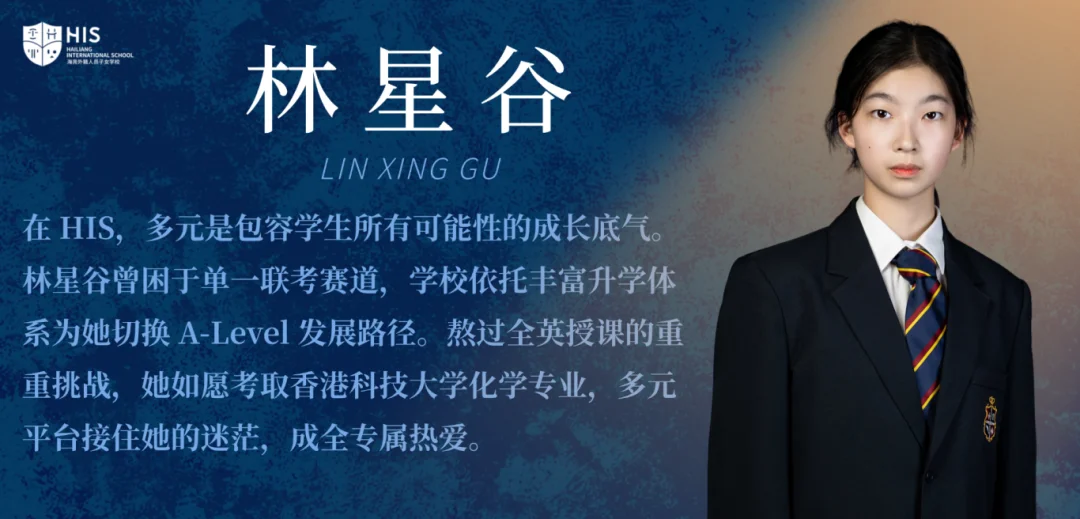
Lin Xinggu’s experience at HIS International School shows why academic fit can be just as important as academic ability. She began with a strong foundation in science, moved from the Hong Kong, Macao and Taiwan Joint Entrance Examination pathway to A-Level courses, adapted to an English-medium classroom and ultimately received an offer to study Chemistry at the Hong Kong University of Science and Technology.
Her progress did not come from following a fixed formula. It came from identifying a mismatch, choosing a more suitable pathway and receiving structured support throughout the transition.
Strong Academic Ability, but an Unsuitable Learning Pathway
When Lin first joined HIS, she chose the Joint Entrance Examination pathway for students from Hong Kong, Macao and Taiwan.
She had clear strengths in science. Her logical reasoning was strong, her academic foundation was solid and chemistry was already the subject that interested her most. The structured curriculum helped her build systematic subject knowledge and disciplined study habits.
However, strong results did not mean that the pathway was the best match for her.
The examination-oriented route placed considerable emphasis on accumulating knowledge, organizing standard answers and preparing for a clearly defined assessment structure. This model can work well for students who prefer steady repetition and standardized output.
Lin learned differently.
She was most engaged when examining chemical principles, exploring experimental variables and asking why a reaction occurred. She preferred open-ended investigation to memorizing conclusions. Over time, the gap between the teaching model and her learning preferences became increasingly visible.
Her difficulty was not a lack of ability or effort. It was a question of academic fit.
A Pathway Change Based on Individual Assessment
Instead of treating the problem as a temporary decline in performance, the HIS academic development team conducted an individual review of Lin’s learning profile.
Teachers considered her subject strengths, classroom behavior, preferred learning methods and long-term interests. Their assessment suggested that an A-Level pathway, with its emphasis on subject depth, experimental understanding and analytical thinking, was better aligned with her academic characteristics.
HIS then supported her transition into the A-Level Chemistry pathway without requiring her to repeat an academic year.
This flexibility is particularly relevant for families evaluating international high schools in China. Having several courses on a school prospectus is not enough. A genuinely flexible school should also have a process for helping students reconsider their choices when their academic needs change.
For Lin, changing pathways was not an escape from difficulty. It was a decision to pursue a more demanding form of learning that suited her strengths.
Crossing the Academic English Barrier
The transition created a new challenge: English-medium academic study.
Lin could communicate in everyday English, but A-Level Chemistry required a different level of language proficiency. She needed to understand specialist terminology, read original textbooks, follow English explanations of complex chemical processes and write formal laboratory reports.
Entering a fully English-medium class immediately could have placed two types of pressure on her at the same time. She would have needed to learn new chemistry content while also decoding unfamiliar academic language.
HIS therefore placed her in a bilingual science transition class based on an English assessment.
Key concepts and difficult scientific principles could initially be clarified in Chinese, helping her maintain progress in Chemistry. At the same time, technical vocabulary, classroom questions, assignments and academic output were increasingly completed in English.
This approach separated language difficulty from subject ability. Lin could continue developing as a chemistry student while gradually acquiring the language needed to express that knowledge.
After one semester of structured preparation and ongoing assessment by her language and subject teachers, she progressed into a standard English-medium class.
“The staged transition was very considerate,” Lin said. “I did not have to face the full pressure of both language and subject knowledge at once. I could adapt gradually and improve step by step.”
Combining Two Learning Systems
Once she had adapted to the language environment, Lin began to combine the strengths of her previous curriculum with the inquiry-based features of A-Level study.
Her earlier education had given her a systematic theoretical foundation. The A-Level pathway encouraged her to go further by examining evidence, controlling experimental variables and explaining the mechanisms behind chemical reactions.
She studied areas including inorganic chemistry, electrochemistry, reaction kinetics and organic synthesis. Instead of stopping at the correct answer, she became increasingly interested in how conclusions were reached and whether different experimental conditions could produce different outcomes.
An interdisciplinary course connecting biology and chemistry also helped her see how chemical knowledge could be applied in pharmaceutical and biomedical fields. This experience clarified her long-term goal: to study chemistry at university and eventually explore medicinal chemistry and drug development.
This development reflects one of the broader purposes of international education in China. The value of an international curriculum lies not only in preparing students for examinations, but also in helping them understand how a subject connects with research, industry and future social needs.
Developing Skills Beyond the Chemistry Classroom
Lin’s growth was not limited to academic content.
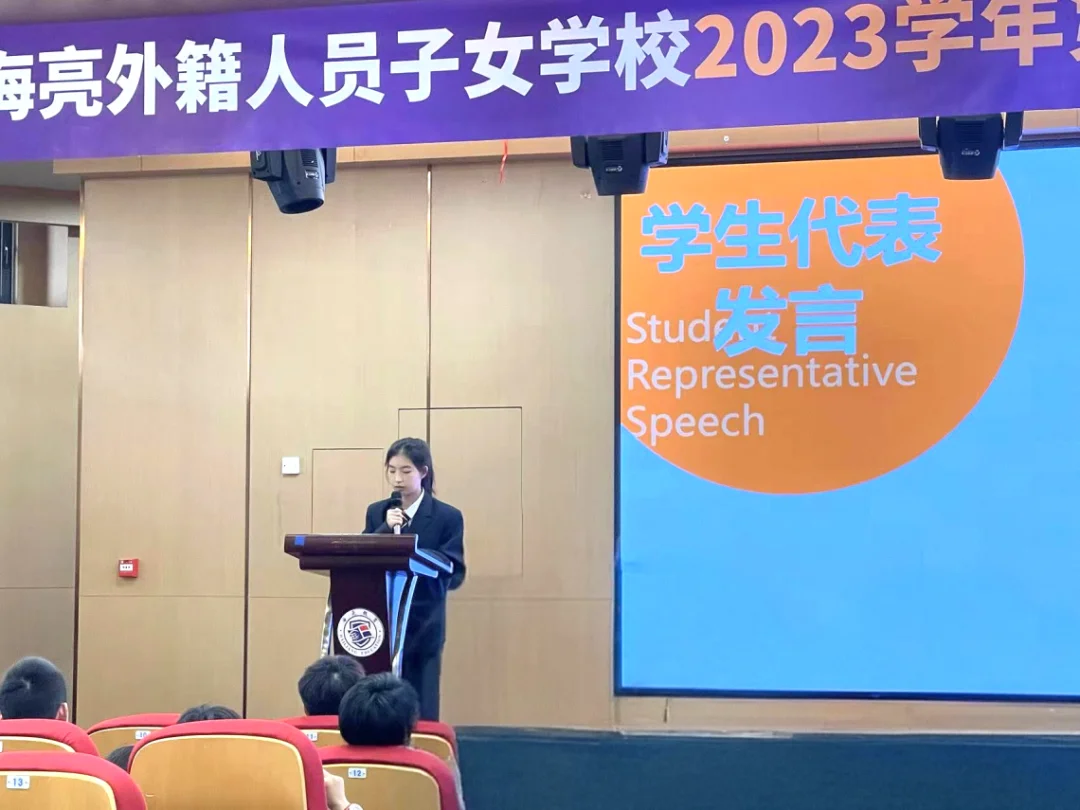
She represented students at a school forum, where she discussed her transition from the Joint Entrance Examination pathway to A-Level study. Preparing for the presentation required her to review her own experience, organize information clearly and refine her English expression.
By explaining her difficulties and the methods that helped her adapt, she strengthened both her communication skills and her confidence.
Lin also participated in the American Mathematics Competitions. Working through complex problems under time pressure trained her to break large questions into smaller steps and evaluate information efficiently.
These habits transferred naturally to Chemistry. They helped her check equations, analyze multiple variables and approach unfamiliar experimental problems more systematically.
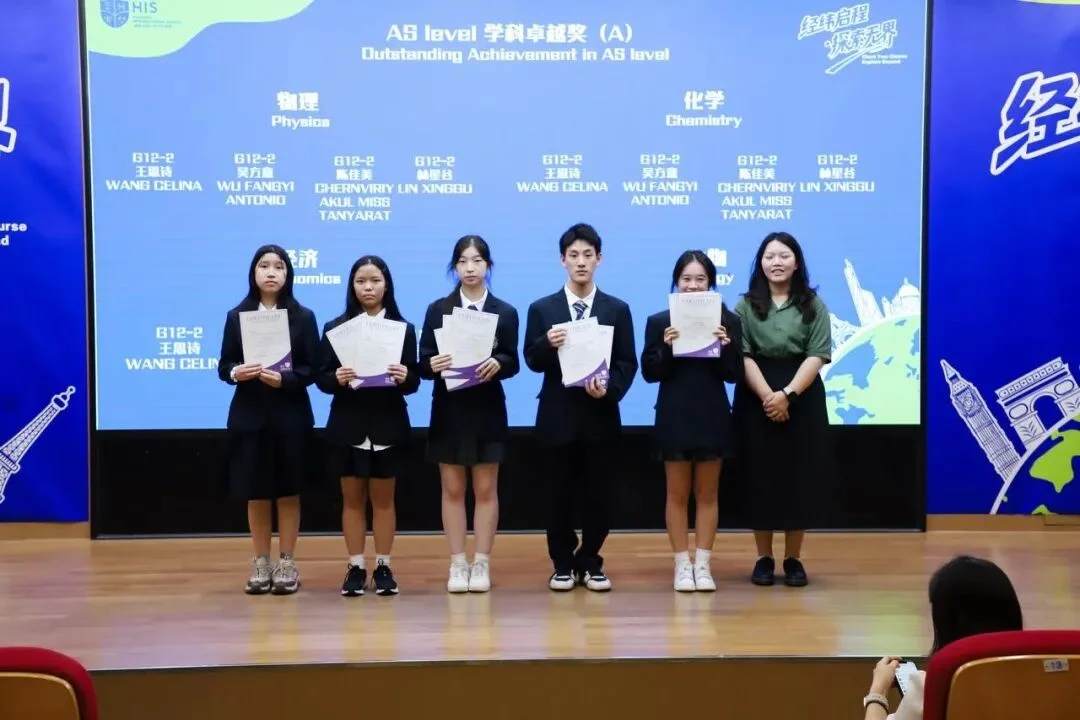
Her consistent academic performance later earned her the school’s Chemistry Academic Excellence Award.
University Guidance Built Around a Long-Term Goal
When Lin began preparing university applications, the HIS university guidance team did not treat rankings as the only criterion.
Counselors considered her interest in pharmaceutical research, her strengths in Chemistry and her intention to pursue further study related to medicinal chemistry. The Chemistry pathway at the Hong Kong University of Science and Technology was identified as a strong match for these goals.
Her application did not rely on a list of awards alone. The personal statement presented a coherent academic journey:
- recognizing that her original pathway was not the right fit;
- making an informed transition to A-Level study;
- overcoming the challenge of English-medium learning;
- developing analytical thinking through Chemistry and mathematics;
- and forming a clear interest in pharmaceutical research.
The counseling team also organized mock interviews covering scientific reasoning and the practical application of Chemistry. Topics included biomedical innovation, green chemistry and environmental responsibility.
This preparation helped Lin communicate not only what she had studied, but also why she wanted to continue studying it.
She ultimately received an offer to study Chemistry at HKUST.
What Parents Can Learn from Lin’s Experience
Lin’s story provides several practical lessons for families considering international schools in China.
1. Curriculum choice should begin with the student
A well-known curriculum is not automatically the right curriculum for every learner. Families should consider how a student processes information, responds to assessment and engages with open-ended tasks.
2. Changing direction is not academic failure
A pathway change can be a responsible decision when it is supported by evidence and professional guidance. Continuing along an unsuitable route simply because it was the first choice may create greater long-term difficulty.
3. Language support should protect subject progress
Students entering English-medium education should not have to abandon academic depth while developing English. Effective transition programs support language and subject learning at the same time.
4. University counseling should connect past experience with future goals
A strong application explains how a student’s choices, challenges and academic interests form a consistent direction. It should not be built entirely around awards or rankings.
5. Individual outcomes cannot be guaranteed
Lin’s admission result reflects her own effort, academic development and application profile. No school pathway can guarantee admission to a particular university. The value of personalized education lies in helping each student make more informed choices and present her abilities authentically.
Finding the Right Path to Future Study
Lin Xinggu was never a student suited to only one academic route. What she needed was the opportunity to recognize the mismatch, reconsider her direction and move forward without losing the progress she had already made.
At HIS, the combination of flexible pathways, bilingual transition support, subject teaching and individual university guidance gave her that opportunity.
For families planning to study in China, the lesson is clear: the right school is not simply the one with the most curriculum options. It is the one that can understand the student behind the application and respond when that student’s needs evolve.
To learn more about the Cambridge and A-Level pathway at HIS, explore the school’s curriculum information or contact the admissions team for an individual consultation.